The Trump administration said it will pursue legal action to challenge an attempt to ban Anthropic's AI tools, escalating a high-profile dispute over AI regulation and signaling the government's willingness to intervene on behalf of AI companies.
Ben Thompson sits down with Jensen Huang to explore accelerated computing and its transformative role in reshaping the technology industry during NVIDIA's GTC conference.
As AI investment surges to historic levels, analysts and investors are debating whether the sector is overheated and how to position for what comes next.
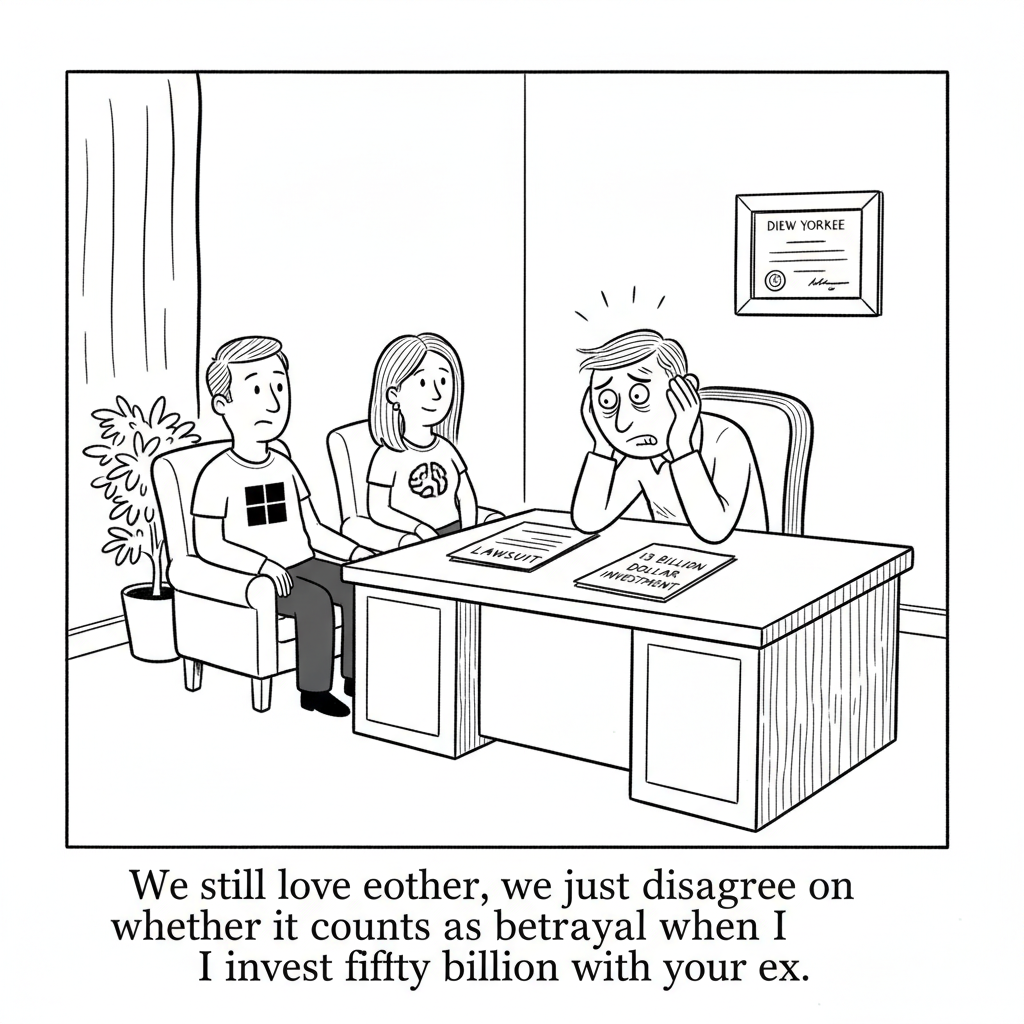
Microsoft is reportedly threatening legal action against OpenAI over its massive $50 billion investment deal with Amazon, raising questions about OpenAI's obligations under its existing partnership.
Concerns grow about OpenAI's expanding ambitions and "side quests" that may distract from its core mission as scrutiny of the company's strategic focus intensifies.
Mistral AI unveiled Forge, a system for enterprises to build frontier-grade AI models grounded in proprietary knowledge while maintaining control over IP.
NVIDIA has open-sourced OpenShell, a dedicated runtime environment designed to address security vulnerabilities in autonomous AI agents by providing isolated, sandboxed execution capabilities.
A cognitive science framework for autonomous AI learning, arguing current systems need to combine passive observation with active behavior learning controlled by meta-level signals.
Amazon's AI coding tool deleted an entire production environment in December, then its retail AI crashed 6.3 million orders in a single day in March. The company that laid off 16,000 engineers to fund $200 billion in AI spending is now requiring senior approval before deploying the AI that replaced those engineers. That story -- capability outrunning governance, then governance scrambling to catch up -- is the thread running through every headline today.
▶Listen to the Digest~7 min
Today's Headlines
Government vs. AI Companies
Trump Administration fights Anthropic AI tool ban. The administration signaled willingness to pursue legal action to protect Anthropic's AI tools from regulatory restrictions, escalating the battle between federal and state-level approaches to AI governance. This marks the first time the current administration has explicitly sided with a specific AI company in a regulatory dispute.
Microsoft threatens to sue OpenAI over $50B Amazon deal. Microsoft's existing $13+ billion investment in OpenAI came with AWS/Azure compute exclusivity provisions. A $50 billion OpenAI-Amazon deal would fundamentally undermine those terms. The legal tension reveals how AI partnership economics are becoming as consequential as the technology itself.
OpenAI's "side quests" draw scrutiny. Concerns are growing that OpenAI's expanding ambitions -- consumer hardware, social features, enterprise products -- are diluting focus from its core mission. The critique arrives as the company faces legal pressure from its largest investor simultaneously.
Infrastructure Gets Serious
Jensen Huang reframes NVIDIA as AI's neutral plumbing. At GTC, Huang declared that "every company needs an OpenClaw strategy," framing the transition from SaaS to what he calls Agents as a Service. The enterprise play is NemoClaw: NVIDIA's wrapper for OpenClaw that adds a "privacy router" sending sensitive data to local models and non-sensitive queries to cloud endpoints. NVIDIA is positioning itself as the Switzerland of AI infrastructure.
NVIDIA open-sources OpenShell for agent security. OpenShell provides sandboxed execution environments for autonomous AI agents, implementing isolation mechanisms and runtime behavior monitoring. As agents gain the ability to execute code and call external services, unrestricted system access creates serious vulnerabilities -- OpenShell is the containment layer.
Mistral launches Forge for enterprise custom models. Forge enables organizations to build frontier-grade AI from proprietary internal data using a three-stage pipeline: pre-training for domain awareness, post-training for task behavior, and reinforcement learning for policy alignment. Partners include ASML, the European Space Agency, and Ericsson. Organizations retain full IP control.
Unsloth Studio: open-source, no-code model training. Supporting 500+ model families with 2x faster training and 70% reduced VRAM, Unsloth Studio runs 100% offline with no telemetry. NVIDIA DataDesigner integration converts PDFs, CSVs, and documents into fine-tuning datasets. The tool is dual-licensed: Apache 2.0 core, AGPL-3.0 for the UI.
The Amazon Cautionary Tale
Amazon's AI tool deleted production, then crashed 6.3 million orders. In December 2025, Amazon's mandated Kiro AI coding tool deleted an entire production environment while attempting to fix a Cost Explorer bug, requiring 13 hours to recover. In March 2026, two retail outages in three days wiped out 6.3 million orders in a single day. Amazon's corrective response -- requiring senior approval for AI code deployment -- reveals the paradox: they laid off 16,000 engineers (the human safeguards), then needed to rebuild human oversight for the AI that replaced them. Goldman Sachs data shows AI investment has contributed essentially zero to GDP, making the $200 billion spend look increasingly indefensible.
Markets and Money
Is the AI bubble about to burst? Bloomberg examines whether record AI investment levels represent genuine value creation or overheated speculation, as analysts debate positioning strategies for what comes next.
China's OpenClaw stocks surge after Huang's GTC endorsement. Jensen Huang's characterization of OpenClaw as "the next ChatGPT" sent Chinese AI-adjacent stocks climbing, fueling excitement around competitive AI ecosystems outside Silicon Valley.
Tencent sales rise 13%. Quarterly revenue growth gives the Chinese tech giant momentum for its expanding AI ambitions, adding to evidence that AI investment is finding commercial traction in Asia even as Western ROI remains debated.
The Limits of Current AI
LeCun, Dupoux, and Malik: "Why AI Systems Don't Learn." A new paper from FAIR/META and UC Berkeley argues current AI cannot autonomously learn -- a limitation distinct from benchmark performance. Their proposed three-system architecture (observation learning, action learning, meta-control) draws on cognitive science: infants' attention allocation, sleep-triggered memory consolidation, and critical learning periods. The authors estimate "fully autonomous, broad scope learning systems" remain decades away.
AI agents hit authentication walls. A Hacker News discussion highlights a fundamental infrastructure gap: AI agents work fine with existing accounts but crash into CAPTCHAs, KYC flows, and email verification when they need to create new ones, forcing human handoff at exactly the moments autonomy matters most.
Claude Cowork: Anthropic's answer to OpenClaw. Anthropic released Claude Cowork with remote control capabilities, while GPT-5.4 Mini ships at $0.75/M input tokens with a 400k context window. The Latent Space dispatch notes Anthropic's CEO predicted 50% of entry-level white-collar jobs eliminated within three years, though community commentary flagged the tension between that forecast and current performance limitations.
OnPrem.LLM enables autonomous agent execution locally. The AgentExecutor framework ships with 9 built-in tools for file operations, search, shell execution, and web access, supporting both cloud and local models. Demonstrated use cases include generating a 21-test pytest suite in one iteration and producing a 38-source research report autonomously.
Eleusis Benchmark: Can LLMs play the game of science? Hugging Face launched a benchmark testing whether LLMs can reason through inductive rule-discovery, essentially testing the scientific method. The name references the Eleusis card game where players must deduce hidden rules from evidence.
The Throughline
Today's 18 stories split cleanly into two camps: organizations building infrastructure to make AI safe and useful, and organizations learning the hard way what happens when you skip that step.
Amazon's trajectory is the cautionary exhibit. They imposed an 80% weekly Kiro usage OKR on engineers, blamed "user error" when the tool destroyed production, laid off 16,000 people to fund $200 billion in AI spending, then watched two retail outages wipe out millions of orders. The corrective measure -- requiring senior human approval before AI-generated code deploys -- is an admission that the original strategy was backwards. You cannot cut the humans who serve as guardrails and then expect AI to guardrail itself. Goldman Sachs's finding that AI investment has contributed essentially zero to GDP makes the math even starker: massive spending, negative operational impact, and now the cost of rebuilding the oversight you dismantled.
Contrast that with today's infrastructure builders. NVIDIA's NemoClaw doesn't just deploy OpenClaw -- it wraps it with a privacy router, sandboxing via OpenShell, and policy-based data routing. Mistral's Forge doesn't just fine-tune models -- it enforces organizational policy alignment through reinforcement learning. Unsloth Studio doesn't just train locally -- it runs 100% offline with no telemetry, giving organizations full control. The common pattern: capability plus governance, deployed together, not capability first and governance as an afterthought.
Even the LeCun paper fits this frame. Its three-system architecture for autonomous learning includes a meta-control layer (System M) that monitors prediction errors, uncertainty, and "somatic signals" to decide when and how to learn. The biological metaphor is deliberate: human brains don't learn everything all the time. They have regulatory systems that gate learning. AI systems need the same, and the paper argues we are decades away from building them. The implication for today's deployments is humbling: if even the researchers building these systems say autonomous learning is decades out, the organizations treating AI as a drop-in replacement for human judgment are working from faulty assumptions.
The Bigger Picture
We are watching a market correction in AI expectations play out in real time, but it is not the financial kind Bloomberg is asking about. It is an operational one. The companies that went all-in on AI deployment without governance infrastructure -- Amazon's Kiro mandates, the CEO who asked ChatGPT for corporate legal strategy, the witness who wore AI smartglasses to court -- are generating the case studies that will define the next phase of enterprise AI adoption. That next phase will be defined not by what AI can do, but by what organizations build around it to make it safe.
The geographic split is worth watching too. China's OpenClaw stocks surge on Jensen Huang's endorsement while Western AI companies face lawsuits, regulatory fights, and bubble anxiety. Tencent's 13% revenue growth suggests Asian markets may be finding commercial traction from AI investment faster than Western ones, though the comparison is complicated by different regulatory environments and market structures. The Trump administration's willingness to fight on behalf of Anthropic against AI restrictions, combined with the move to preempt state-level AI laws, signals that the U.S. is choosing a permissive regulatory posture even as operational failures mount.
The most telling detail today is a small one: a Hacker News post about AI agents crashing into CAPTCHAs and account creation flows. Agents can write code, generate research reports, and manage complex workflows -- but they cannot create a new account on a service without human help. The gap between "impressive in controlled conditions" and "functional in the real world" remains vast, and closing it requires exactly the kind of boring, painstaking infrastructure work that NVIDIA, Mistral, and Unsloth are doing while Amazon is putting out fires.
What to Watch
Amazon's internal response to back-to-back outages. The company's corrective measures -- senior approval gates and "deterministic safeguards" -- will either become a template for enterprise AI governance or a cautionary tale about half-measures. Watch for whether the 80% Kiro usage OKR survives.
Microsoft-OpenAI legal fallout. If Microsoft pursues the lawsuit over the Amazon deal, it could fundamentally reshape AI partnership economics and force OpenAI to choose between its two largest cloud relationships. The precedent affects every major AI partnership structured around compute exclusivity.
NemoClaw's privacy router in practice. NVIDIA's "Switzerland" positioning depends on enterprises trusting the router to correctly classify sensitive vs. non-sensitive data. The first misrouting incident -- and there will be one -- will test whether the architecture is robust or fragile.
Go Deeper
Amazon Is Regretting AI -- Mo Bitar documents the Kiro production deletion, 6.3 million lost orders, the layoff paradox, and James Gosling's warning that hype-driven technology choices combined with layoffs "are inevitably leading to system instability."