Microsoft's terms of service classify its Copilot AI assistant as software intended for "entertainment purposes only," a legal classification that effectively disclaims liability for any advice, code, or output the tool generates for the millions of enterprise and consumer users who rely on it daily.
The revelation raises uncomfortable questions about the gap between how AI companies market their products and the legal protections they quietly build into their terms of use, particularly as businesses integrate these tools into critical workflows.
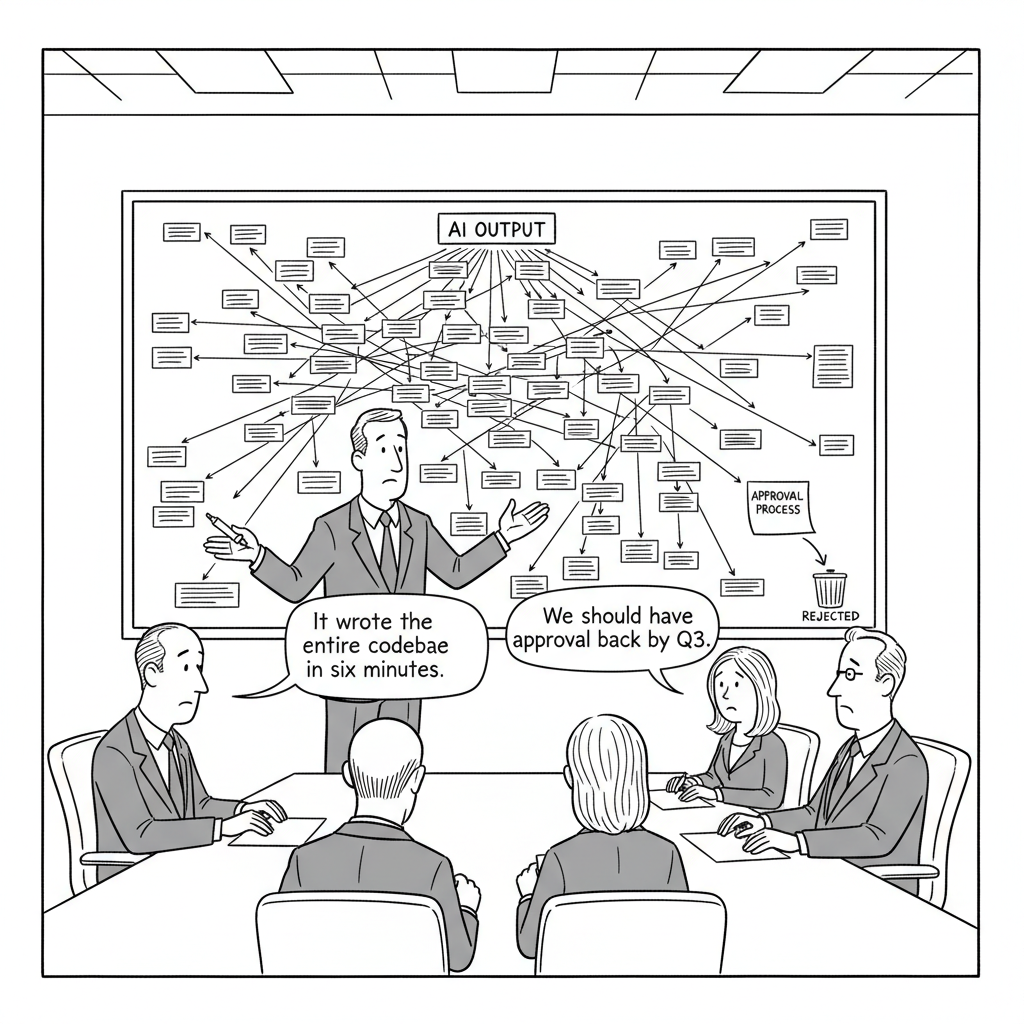
Jones argues that AI agents expose organizational bottlenecks: agents produce at 100x speed but orgs review at 3x, requiring clarity of intent, clean data, and fundamental process redesign.
Japan is accelerating the deployment of physical AI systems from experimental pilots into real-world operations. Driven by severe labor shortages rather than workforce displacement concerns, the country is proving that embodied AI can fill roles in manufacturing, elder care, and logistics that humans increasingly refuse to take.
An opinion piece exploring the ethical dimensions of AI chatbot-generated writing and its implications for authorship, creative integrity, and the blurred line between human and machine expression in an age when most readers cannot tell the difference.
Retail startups are leveraging AI-powered virtual try-on technology to cut return rates and improve profit margins in e-commerce, signaling a shift from gimmick to core business strategy.
Matt Maher demonstrates how Claude Cowork can transform a simple email question into a fully automated running system, showcasing practical AI workflow automation without writing a single line of code.
TechCrunch's Equity podcast debates whether space-based data centers could support SpaceX's substantial company valuation, examining Elon Musk's vision for orbital AI infrastructure and the engineering challenges that stand in the way.
Lalit Maganti spent eight years contemplating and three months building syntaqlite with AI assistance. Simon Willison highlights both the benefits and significant pitfalls of using AI agents for software development, particularly regarding architectural decisions.
Maganti's firsthand account of building a high-quality SQLite developer tool in three months using AI coding agents, and where AI created as many challenges as it solved.
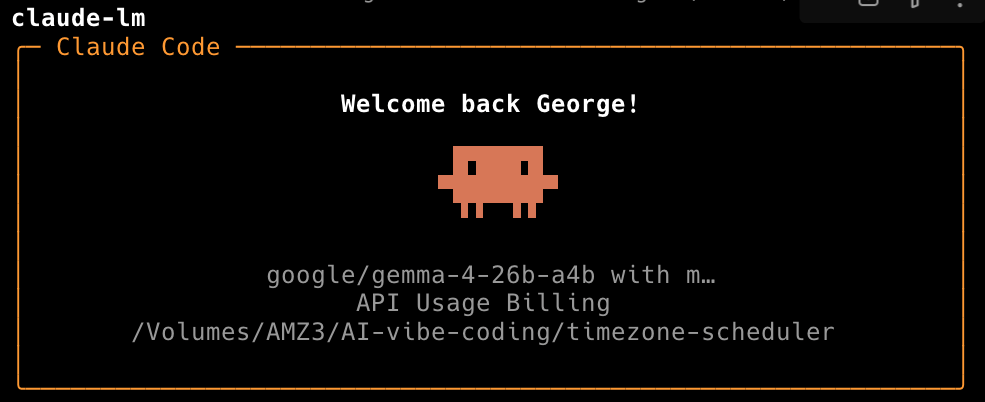
A guide to setting up Gemma 4 26B for local inference on macOS using LM Studio 0.4.0's new llmster and lms CLI tools, with integration into Claude Code for hybrid local/cloud workflows.
Acronym Quiz
Test your AI vocabulary. What does each acronym stand for?
Google's new iPhone app runs Gemma 4 models entirely on-device, featuring image analysis, audio transcription, and interactive tool-calling demonstrations. No cloud, no API keys, no data leaving your phone.
Microsoft tells millions of enterprise users to trust Copilot with their work, then buries "for entertainment purposes only" in the terms of service. Across the Pacific, Japan is deploying robots not to replace workers but to fill jobs nobody wants. A $14,000 voice agent looked functional on day one but collapsed by month two because nobody mapped the actual process first. And a developer spent eight years thinking about a project, then built it in three months with AI, only to throw away the entire first month's work. Today's issue is about the gap between what AI tools promise and what organizations are actually prepared to handle.
▶Listen to the Digest~7 min
Today's Headlines
The Trust Gap
Microsoft's Copilot: Entertainment Only - Microsoft aggressively markets Copilot as a productivity powerhouse deeply integrated into Office 365, while its terms of service simultaneously classify the tool as "for entertainment purposes only." This isn't just legal fine print. It's a structural disclaimer that effectively absolves Microsoft of liability for any advice, code, or output Copilot generates. The gap between marketing and legal language is becoming an industry pattern: companies sell AI as indispensable while quietly hedging that nothing it produces should be trusted.
Washington Post: AI Writing Ethics Hit the Newsroom - A Washington Post opinion contributor describes asking a chatbot to compile social media analysis, only to receive results "riddled with hallucinations, unnecessary apologies, and search results that missed the mark entirely." The piece argues that AI's promise as a journalistic tool collides with its current inability to produce reliably accurate outputs, and that transparent disclosure of AI use in newsrooms is no longer optional.
AI Meets the Physical World
Japan's Robots Fill the Jobs Nobody Wants - Japan is transitioning physical AI from pilot projects into sustained deployment across manufacturing, elder care, and logistics, driven by demographic decline so severe that the country simply cannot fill positions with human workers. The narrative is fundamentally different from Western automation anxiety: these robots aren't displacing workers, they're filling roles that have been vacant for years. Salesforce Ventures, Global Brain, and Woven Capital (Toyota's investment arm) have all backed the sector, signaling that this is no longer experimental.
Virtual Try-On Tech Becomes a Margin Play - CNBC reports that ASOS achieved a 160 basis point reduction in returns by partnering with deep-tech startup AIUTA on virtual try-on technology. Catches, another AI startup in the space, projects a 10% conversion increase and 20-to-30x ROI for brand partners. What was once a gimmick is becoming core retail infrastructure, with Amazon, Adobe, and Google all developing competing solutions.
Orbital Data Centers: SpaceX's Valuation Play - TechCrunch's Equity podcast debates whether Elon Musk's vision for space-based data centers, with their unlimited solar power, natural cooling, and zero land constraints, could generate enough revenue to justify SpaceX's valuation. The engineering challenges remain enormous, but the terrestrial data center industry is running into genuine physical limits.
Agents vs. Organizations
The 100x Production, 3x Review Problem - Nate B Jones presents a concrete case study: a $14,000 voice agent that looked functional but created scattered, unstructured data with no schema, making funnel measurement impossible by month two. His core framework: agents don't solve organizational problems, they expose them. Jones offers five commandments for deployment, audit before automating (including tribal knowledge), fix data first, redesign the org for throughput, build observability on day one, and scope authority deliberately. The most striking insight: when ad creative scales from 20 to 2,000 pieces, humans shift from execution to system design and quality management, a fundamentally different skill set that nobody is training for.
Claude Cowork: From Email Question to Running System - Matt Maher's demonstration of building a scheduled email dashboard in Claude Cowork surfaces a deeper principle: the most common AI prompting mistake is over-specifying implementation details instead of describing desired outcomes. His system processed 13 emails out of 123 in its first run, and the dashboard design went through seven rounds of iterative agent-team refinement. The concept of "personal software," tools built for exactly one person where changes happen conversationally, challenges every assumption in traditional software development.
Building With AI (and Rebuilding After)
Eight Years of Wanting, Three Months of Building - Lalit Maganti's account of building syntaqlite is the most honest assessment of AI-assisted development published this year. AI overcame eight years of paralysis by "converting abstract concerns into concrete problems," but the first month of "vibe-coding" produced 500+ tests and completely unsustainable architecture that had to be discarded. His critical distinction: AI excels where correctness is objectively verifiable (code compiles, tests pass) but fails at architectural decisions where no such metric exists. The successful rebuild treated AI as "autocomplete on steroids" with human ownership of all decisions. Simon Willison highlights the "uncomfortable parallel between using AI coding tools and playing slot machines."
Gemma 4 at 51 Tokens/Second on a Laptop - George Liu achieves 51 tokens/second running Gemma 4 26B locally on a MacBook Pro M4 Pro with 48GB, using LM Studio 0.4.0's new headless CLI. The Q4_K_M quantization occupies 17.99GB, scaling to 37.48GB at 256K context. Key finding: speculative decoding caused a 54% slowdown with MoE models, and the system showed real memory pressure at 48GB with 27.49GB swap used during testing. He provides a shell function for routing Claude Code through the local server, enabling hybrid local/cloud workflows.
Google AI Edge Gallery - Simon Willison calls it "a terrible name, really great app." Google's official iPhone app runs Gemma 4 models entirely on-device, with the E2B variant requiring a 2.54GB download and delivering "fast and genuinely useful" performance. The app includes eight interactive tool-calling demo widgets, though Willison notes the tool-calling demo "froze the app when I tried to add a follow-up prompt." This is the first time a local model vendor has released an official iPhone app for on-device inference.
Open Source Roundup
Caveman (2,900 stars) reduces Claude Code token usage by ~75% by making the AI speak in terse, caveman-style language while preserving technical accuracy. GuppyLM (999 stars) is a 9M-parameter model trained to talk like a pet fish, designed as an educational tool that demystifies LLM training in a 5-minute Colab notebook. Parlor (484 stars) enables real-time multimodal voice and vision conversations running entirely on-device using Gemma 4 E2B, with ~2.5-3 second end-to-end latency on an M3 Pro. Gemma-Gem (225 stars) is a Chrome extension running Gemma 4 entirely via WebGPU with native DOM tools. Modo (79 stars) is an open-source AI IDE that introduces spec-driven development where prompts become structured requirements before code generation.
The Throughline
The thread connecting every story in today's issue is the gap between AI capability and institutional readiness. Microsoft can build Copilot into every Office product on earth, but its own lawyers won't let it be classified as anything more than entertainment. Japan can deploy physical robots in factories, but only because demographic collapse left no alternative, not because the regulatory and cultural frameworks were ready. Nate B Jones's $14,000 voice agent could handle calls at superhuman speed, but the org had no schema, no observability, and no plan for what happens when output scales 100x while review capacity stays at 3x.
Lalit Maganti's syntaqlite story crystallizes this at the individual level. AI let him build in three months what he'd contemplated for eight years. But the first month's work, 500+ tests, a functioning prototype, all of it was architecturally unsound. AI is exceptional at implementation where there's an objective correctness metric. It's actively dangerous at design decisions where no such metric exists. The slot machine parallel Willison highlights is real: the tool keeps producing outputs that look right, and the human keeps pulling the lever, and fatigue compounds the judgment errors until you're rebuilding from scratch.
The same pattern plays out at the infrastructure layer. George Liu can run Gemma 4 locally at 51 tokens/second, but 48GB of RAM isn't enough, swapping 27.49GB to disk during testing. Google ships an iPhone app that runs models on-device, but tool-calling freezes the app. Caveman cuts Claude Code token costs by 75%, but only by stripping the natural language interface that's supposed to be the whole point of LLMs. Every solution introduces its own constraint. The tools are ready. The environments they run in are not.
What makes this moment distinctive is that the gap isn't closing. It's widening. Microsoft's terms of service are getting more conservative while its marketing gets more aggressive. Japan's labor shortage is deepening while its robot deployments are expanding. The open-source AI ecosystem is shipping faster while the organizational capacity to evaluate, integrate, and maintain these tools remains roughly constant. The tools accelerate. The institutions don't.
The Bigger Picture
We're entering a phase where AI's most significant impact isn't the technology itself but the institutional stress tests it creates. Microsoft's "entertainment only" classification isn't a bug in legal drafting. It's a signal that the liability frameworks for AI-generated output don't exist yet, and companies know it. Rather than wait for regulators to define the rules, they're preemptively disclaiming responsibility while maximizing adoption. This is rational behavior for individual companies and deeply irrational for the system as a whole: millions of professionals are building workflows around tools whose own makers won't vouch for their reliability.
Japan offers the most instructive counterexample. Instead of debating whether AI will take jobs, Japan deployed robots into roles that were already empty. The question wasn't "should we automate?" but "can we function without automation?" This isn't just a demographic story. It's a preview of how AI adoption actually happens at scale: not through top-down strategic transformation, but through the quiet pressure of operational necessity. The organizations that adopt AI fastest won't be the ones with the best AI strategies. They'll be the ones with no other choice.
Meanwhile, the developer ecosystem is producing a striking split. On one side, tools like Gemma-Gem and Google's AI Edge Gallery are pushing inference entirely to the edge, no cloud, no API keys, no data leaving the device. On the other, Caveman's success (2,900 stars for a tool that makes AI talk like a caveman) reveals that current AI infrastructure is too expensive for sustained professional use without aggressive optimization. When the most popular Claude Code community plugin exists to make the tool talk less, the economic model has a problem. The next twelve months will determine whether the industry solves this through cheaper models, better infrastructure, or, more likely, by shifting costs to users through the kind of terms-of-service maneuvering Microsoft just demonstrated.
What to Watch
The liability question for AI-generated output. Microsoft's "entertainment only" classification is a placeholder. Watch for the first major lawsuit where a company's AI-generated output causes measurable harm and the terms of service defense gets tested in court. The ruling will define the legal framework for every AI product on the market.
Japan's deployment data as a leading indicator. Japan is the only major economy deploying physical AI at scale in response to genuine labor shortages rather than cost optimization. Watch for productivity and quality metrics from the sectors receiving robots, particularly elder care and manufacturing, as these will be the first real-world benchmarks for sustained AI-human collaboration.
The org redesign problem. Jones's framework, that agents expose rather than solve organizational weakness, is about to collide with enterprise adoption at scale. Watch for Q2 enterprise AI deployment reports: if companies report "pilot fatigue" or "month 2-3 failures," his diagnosis is correct and the bottleneck isn't the technology but the review and governance layer surrounding it.
Go Deeper
Your Agent Produces at 100x. Your Org Reviews at 3x. - Jones's five commandments for agent deployment are concrete and immediately actionable. The $14,000 voice agent case study alone is worth the read, illustrating exactly how a seemingly functional system collapses when nobody maps the actual data flow. The "mini-me fallacy" framework, where orgs try to make agents replicate individual contributors instead of building dedicated agent pipelines, explains most enterprise AI deployment failures.
I Asked Claude Cowork About My Email. It Became a Running System - Maher's concept of "personal software," tools built for exactly one person where breakage is fixed conversationally, challenges fundamental assumptions about software development. The agent-team design approach (UX designer, developer, and reviewer agents iterating in parallel) is a practical workflow pattern worth stealing, and his distinction between automation and collaboration reframes how to think about AI tool adoption.