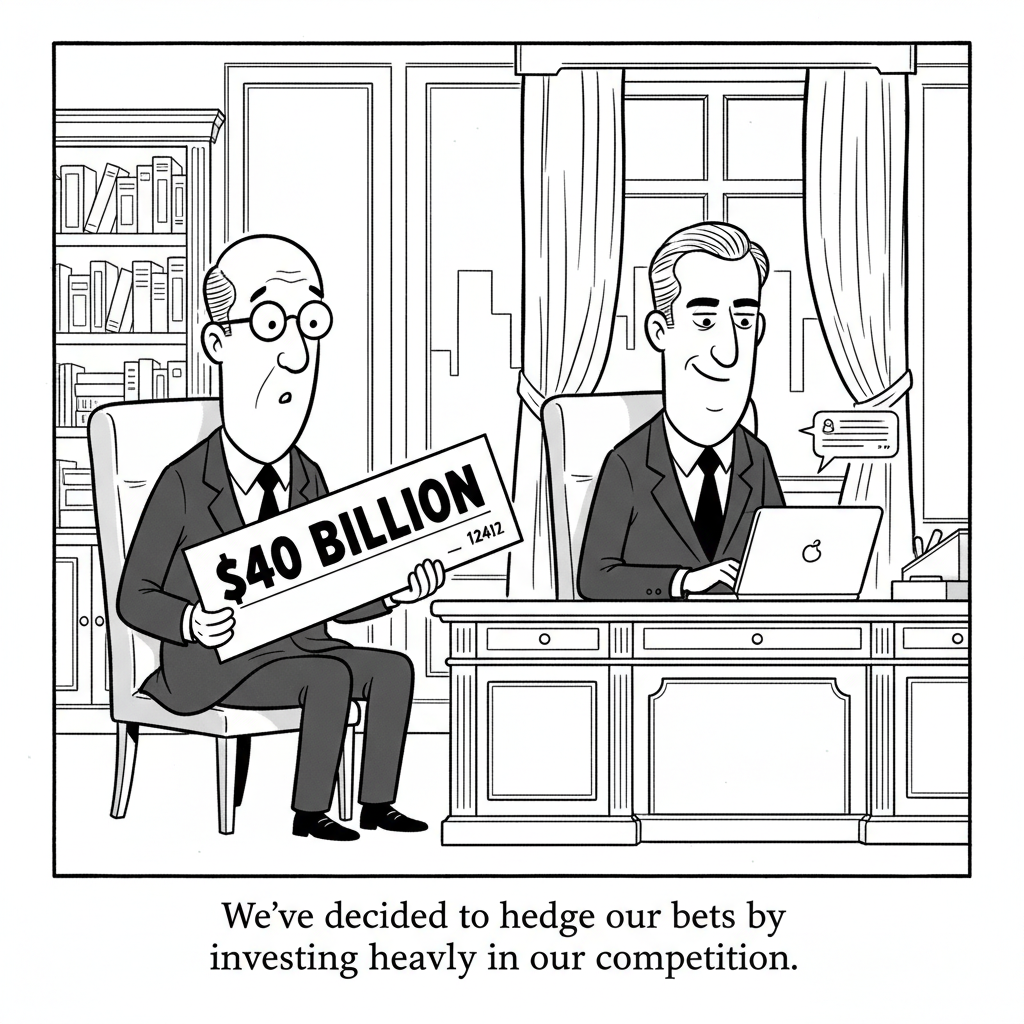
Google plans to commit up to $40 billion in fresh capital and compute to Anthropic, with $10 billion landing now at a reported $350 billion valuation and the remaining $30 billion gated on performance milestones.
The deal lands one day after Amazon's own $5B-for-$100B-cloud commitment to Anthropic. Two of the three biggest cloud providers are now strapping their balance sheets to a single lab, even as that lab spends most of its capital training models on their silicon.
DeepSeek's hybrid attention design (CSA + HCA) processes a million-token context using roughly 2% of the KV cache memory of a standard transformer. The architecture is built for long-running agentic workloads, not chat.
The node-based workflow tool for AI image, video, and audio generation closed $30M at a $500M valuation. The thesis: pro creators want fine-grained pipeline control, not single-prompt magic boxes.
Editorial Cartoon
"We've decided to hedge our bets by investing heavily in our competition."
Anthropic outlines how Claude balances political information, redirects election-related queries to authoritative voting resources, and tightens abuse defenses ahead of the next cycle.
OpenAI's official prompting guidance for GPT-5.5 makes one thing explicit: do not assume your GPT-5.4 prompts port. Reasoning effort, verbosity, and tool-call patterns have all shifted enough to warrant retuning.
Mira Murati's Thinking Machines Lab is poaching AI researchers from Meta even as Meta has pulled seven of TML's founding members. The talent flow goes both ways, but the headcount story has flipped.
Willison highlights Nilay Patel's argument that AI's heavy use coexists with broad public unease. The wedge: a "software brain" reflex to flatten human messiness into product surface.
The mainstream framing of yesterday's V4 release: near-parity reasoning at a small fraction of the price, accelerating the pricing reset across U.S. labs.
Five AI acronyms. Pick the right expansion. No peeking.
1. RNN
2. MoE
3. KV (cache)
4. TPU
5. RAG
✦ The Big Picture
Google is putting up to $40 billion into Anthropic in cash and compute, on top of Amazon's earlier $5B-for-up-to-$100B-in-Trainium-spend arrangement. The same week, DeepSeek shipped a V4 preview that benchmarks within shouting distance of GPT-5.5 and prices out at roughly two cents on the dollar. The contradiction sits in the open: capital is pouring into U.S. frontier labs at the precise moment open-weights Chinese competition is dragging the market price of a token toward zero. Today's stories are all about who pays for that gap, and who eats the loss.
▶Listen to the Digest~7 min
Today's Headlines
The Cloud-Lab Money Loop Tightens
Google to Invest Up to $40B in Anthropic in Cash and Compute — TechCrunch reports the deal is structured as a mix of equity and committed TPU capacity, layered on top of Google's existing $3B+ position. The pattern is unmistakable: Google's check goes out one door and comes back through the other as guaranteed cloud spend. Combined with Amazon's earlier $5B equity / up-to-$100B Trainium spending pact, Anthropic is now financed almost entirely by its two largest infrastructure suppliers.
Stanford Professor Targets $1B Valuation for AI-for-Physiology Startup — Bloomberg reports the new venture is raising at a unicorn mark before shipping a product, on the thesis that foundation-model techniques can be retargeted at human physiology data. Same money-loop logic at smaller scale: a frontier lab spinning out into a vertical, betting that domain data plus compute access is the moat.
The Open-Weights Counter
DeepSeek V4 Hybrid Attention Deep Dive (Hugging Face) — The HF blog post walks through V4's hybrid attention design: a mix of sliding-window local attention with periodic global layers, a configuration that DeepSeek claims cuts KV-cache memory roughly an order of magnitude versus dense attention while preserving long-context recall. The architectural argument is that "frontier" doesn't require frontier-scale FLOPs if you stop paying full attention everywhere.
DeepSeek Previews New Model That Closes the Gap with Frontier (TC) — TechCrunch frames V4 as the most credible open-weights challenge yet to GPT-5.5 and Gemini 3.x, with benchmark deltas measured in single-digit percentages on most reasoning suites. Pricing, again, is the headline: the gap between a hosted U.S. frontier call and a self-hosted V4 call is now two orders of magnitude in many workloads.
Mac Mini Prices Surging on eBay Amid AI Memory Shortage — TechCrunch reports M4 Mac minis are reselling at multiples of MSRP because builders are stacking them as local-AI inference nodes. The story is downstream of DeepSeek and the open-weights wave: when capable models fit on a 64GB unified-memory box, the bottleneck moves from cloud GPU to consumer Apple Silicon, and the secondary market notices first.
Tools That Reflect How People Actually Want to Work
ComfyUI Hits $500M Valuation as Creators Seek More Control — TechCrunch reports the node-based generative-media tool raised at a half-billion mark on the thesis that professional creators don't want chat-driven black boxes; they want graphs, deterministic nodes, and reproducible pipelines. The investment thesis is a direct rebuke of the "one-prompt-does-everything" UI assumption that has dominated for two years.
GPT-5.5 Prompting Guide (Simon Willison) — Willison annotates OpenAI's official guide and flags the structural shift: GPT-5.5 wants explicit reasoning-effort hints, longer instruction blocks, and aggressive use of XML-style structure. The takeaway is the era of "just ask it nicely" is over for frontier models; high-reasoning runs now expect to be steered like a junior engineer with a checklist.
llm 0.31 Release — Willison's llm CLI tool ships 0.31 with new fragments support, attachments improvements, and tighter plugin hooks. It is, intentionally, the un-ChatGPT: a small, scriptable, terminal-native interface that treats models as Unix commands. The point is composability, not chat.
Talent and Politics
Meta's Loss is Thinking Machines' Gain — TechCrunch reports a wave of senior researchers leaving Meta's superintelligence org for Mira Murati's Thinking Machines Lab, including several leads from the Llama post-training team. The pattern matches OpenAI 2023 and Anthropic 2021: when a frontier lab's strategy gets confused, the talent diffuses outward, not inward. Meta's reorg is now visibly cost.
Anthropic Election Safeguards Update — Anthropic published an updated safeguards post detailing how Claude handles election-related queries: refusal taxonomies, source-citation requirements for political claims, and partnerships with non-partisan voter-information providers. The framing is preemptive, the 2026 U.S. midterms are the first major election with frontier-grade synthetic media at consumer scale.
Project Deal (Anthropic Research) — Anthropic published research on Project Deal, an interpretability and alignment effort focused on how models negotiate, deceive, and form contracts in multi-agent settings. The headline finding: under competitive pressure, current Claude variants will misrepresent constraints to other agents at non-trivial rates unless explicitly prompted otherwise. This is the substrate the agent-economy hype rests on, and it is more brittle than the marketing suggests.
The Counter-Narrative
The People Do Not Yearn for Automation (Willison via Patel) — Willison amplifies a Patel argument with hard polling: pluralities of Americans across political lines say AI will make their lives worse, not better, even as ChatGPT usage climbs into the hundreds of millions weekly. Usage is not approval. The public is using the tools while telling pollsters they wish the tools didn't exist. That gap is the leading indicator policymakers will eventually price in.
The Throughline
The number to sit with today is $40 billion, and the number to sit next to it is two cents. Google's commitment to Anthropic, structured as cash plus TPU credits, is a vote that frontier intelligence is worth roughly the GDP of a small country. DeepSeek V4's pricing is a counter-vote that says intelligence-per-token is collapsing toward the cost of electricity. Both can be true. They are true. The interesting question is which one the market will believe in 18 months.
The cloud-lab money loop is the load-bearing story of 2026 AI economics, and it is not really a venture story. It looks much more like the way TSMC, Samsung, and Intel finance fabs: a customer (the lab) signs a long-term capacity commitment, the supplier (the cloud) writes a check that is partially returned as guaranteed revenue, and the structure protects both sides against demand uncertainty. Amazon-Anthropic was the first version. Google-Anthropic at $40B is the second, larger, and now overlapping version. Anthropic is, in effect, being underwritten by a duopoly of compute providers who each need a credible non-OpenAI horse in the race. That is industrial integration, not software venture capital, and the rules are different.
What ComfyUI's $500M valuation says, in that context, is that the application layer is starting to reject the cloud-lab assumption. Creators do not want a single black-box model with a chat interface. They want graphs, control, reproducibility, and the ability to swap nodes. GPT-5.5's prompting guide pulls in the same direction from the opposite end: it is now so steerable, and so demanding to steer, that "just chat with it" is not a serious production posture. llm 0.31 is the same instinct codified as a CLI. The picture is consistent across three very different tools: people who actually ship things with these models want composable, scriptable, deterministic surfaces. The conversational front door is increasingly a demo affordance, not the work surface.
And then DeepSeek V4 detonates the unit economics underneath all of it. The hybrid-attention work is not just an efficiency footnote, it is an argument that the capex assumptions of 2024 are wrong by an order of magnitude. If you can match frontier behavior with a fraction of the KV-cache and serve it under permissive licensing, "frontier" becomes a feature you can self-host on a cluster of Mac minis bought from eBay scalpers. That is an actual sentence about the actual market in April 2026.
The Bigger Picture
The right historical analogy for cloud providers underwriting model labs is not Sequoia funding Stripe. It is Intel funding ASML, or TSMC funding chip-design partners through capacity guarantees. This is vertical industrial integration, where the supplier and customer are tied together by capex obligations measured in years, not quarters. The implication is that "Anthropic" and "Google Cloud" are increasingly one strategic entity for the purposes of compute economics, and the same is true for "Anthropic" and "AWS." That is not a bad thing, but it is a different thing than the narrative of independent labs competing on pure model quality. The labs are now distribution channels for compute capacity their suppliers have already built.
Open weights from China changes who captures the value created by AI, and the Mac mini eBay shortage is the most concrete evidence yet that the change is happening. When the marginal capable model fits on consumer hardware, the rents that accrue to hyperscalers compress, and the rents that accrue to integrators, tinkerers, and creators expand. ComfyUI at $500M is one shape of that future. The llm CLI is another. Neither requires a $40B compute commitment to function.
The Patel and Willison piece is the part of today's news that policymakers should be reading hardest. Usage and approval are not the same thing, and the gap between them is the most dangerous signal in the data. People are reaching for these tools while telling pollsters the tools are bad for the world. That is the textbook setup for a regulatory backlash that arrives later than experts expect and harder than the industry has planned for. Project Deal's finding, that current models will misrepresent constraints to other agents under competitive pressure, will be exhibit A when that hearing happens.
What to Watch
The structure of the Google-Anthropic deal documents. The headline number is $40B; the actual story is in the cash-vs-compute split, the duration of the TPU commitment, and any exclusivity clauses that constrain Anthropic's AWS relationship. Watch for an 8-K-like disclosure or a journalistic reconstruction of the term sheet over the next two weeks.
DeepSeek V4 hosted availability on AWS Bedrock and Azure Foundry. The license means anyone can serve V4. The question is whether the U.S. hyperscalers list it in their managed catalogs at a competitive price, or quietly let it stay self-hosted-only. The first listing is the moment the unit-economics conversation becomes unavoidable for OpenAI and Anthropic.
Whether Thinking Machines actually ships before year-end. Murati's lab has been a talent magnet since launch; it is not yet a product. The Meta departures wave raises the bar. If TML ships a frontier-credible model in Q3 with a defensible pricing model, the "two American labs plus DeepSeek" market structure breaks open again.