Anthropic has acquired Stainless, the four-year-old startup whose software generates the SDKs and MCP servers that developers use to wire applications into AI models. The framing in Anthropic's own announcement is about connectivity: Claude's value increasingly depends on how cleanly it reaches into a customer's data and tools, and Stainless is the layer that makes that plumbing reliable.
The detail that makes this more than a tuck-in is who else was a customer. Stainless's SDK-generation software was used by OpenAI, Google, and Cloudflare, the very labs Anthropic competes with most directly. Buying the connective tissue that your rivals also depend on is a different kind of move than buying a feature, and it reframes the agent race around who owns the integration layer, not just the model.
The Deal
$300M+
Founded 2022
SDKs · MCP Servers · Agent Connectivity
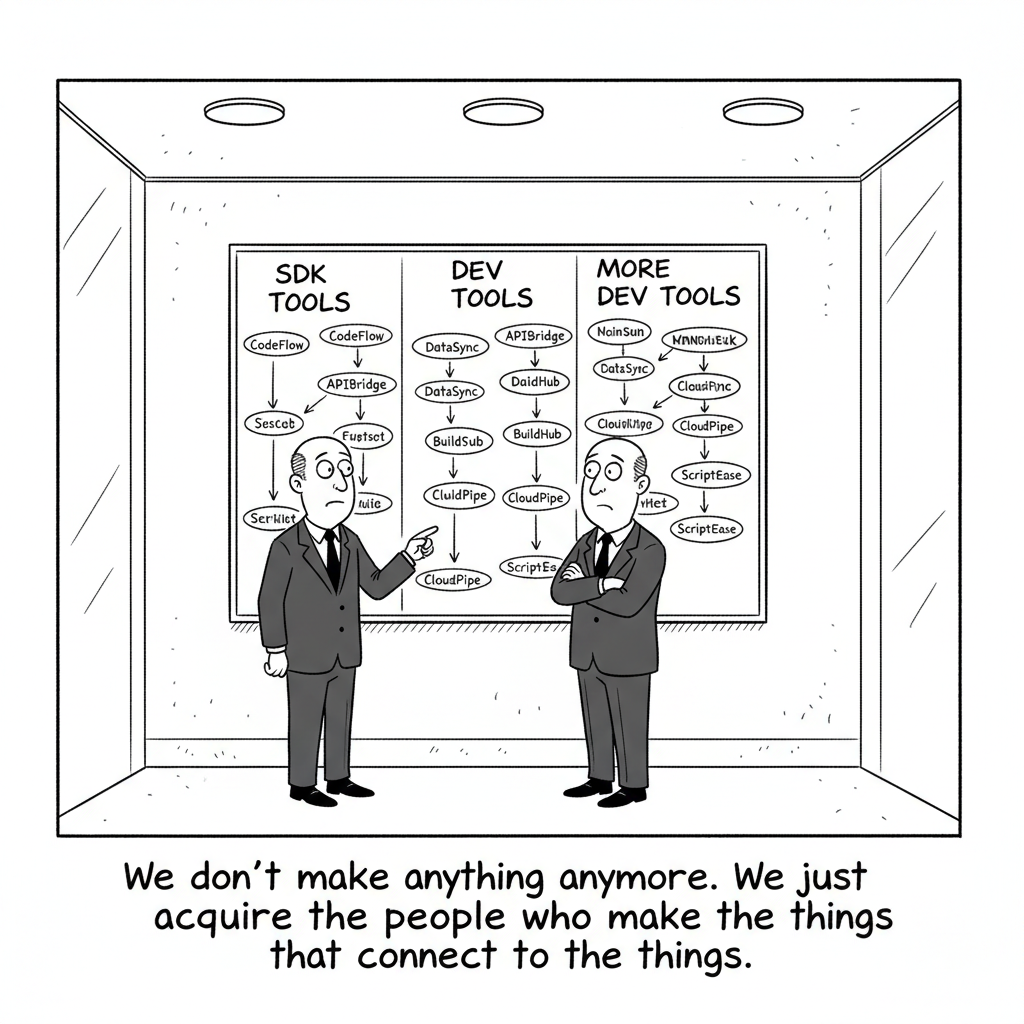
Cartoon · The Fit to Prompt
"We don't make anything anymore. We just acquire the people who make the things that connect to the things."
TechCrunch puts a number on the Stainless deal: more than $300 million for a company founded by former Stripe engineer Alex Rattray, whose SDK-generation software became quiet infrastructure across competing AI labs. The reporting underlines the strategic awkwardness, Anthropic now controls a dependency that OpenAI and Google ship against, and frames it as a bet that the integration layer is where agent platforms are won.
A unanimous jury rejected Elon Musk's case against Sam Altman and OpenAI, finding the claims time-barred under the statute of limitations. After this week's deliberation watch, the verdict closes the central legal threat to OpenAI's for-profit conversion, at least on Musk's theory of the case, and removes one of the larger overhangs on the company's structure.
Google is reportedly partnering with Blackstone to stand up a dedicated AI cloud business, according to a Wall Street Journal report relayed by Bloomberg. Pairing a hyperscaler's compute with a private-equity balance sheet is the same financialized-infrastructure pattern showing up across the buildout: capital, not capability, is increasingly the gating resource for AI at scale.
SandboxAQ has wired its scientific models for drug discovery and materials science directly into Claude, so researchers can run them through a conversational interface instead of specialized computing pipelines. It is a concrete instance of the connectivity thesis behind today's lead: the model becomes a front end for domain tools, and the integration is the product.
Willison's annotated PyCon US 2026 lightning talk compresses half a year of LLM progress into a single fast read, with coding agents and open-weight model gains as the throughlines. It is a useful sanity check against the acquisition noise: the underlying capability curve is still moving regardless of who owns the plumbing.
Ben Thompson takes the local opposition to data centers seriously rather than dismissing it, then argues the only durable fix is straightforward: pay the affected communities. Read against the Google-Blackstone story, it is the political bill arriving for the same infrastructure boom that private capital is rushing to finance.
The Economist is testing agent-readable versions of its content and restructuring how it builds products with generative tools, planning for a web where AI agents are a first-class audience. It is the publisher-side mirror of the same connectivity shift Anthropic is buying into: content, like code, is being refactored for machine consumers.
Scramble
Unscramble each answer. The red letters spell the bonus word.
TSCPOAD
Audio show Amazon's Alexa+ can now generate on demand (7)
LOSDEM
What SandboxAQ brought to Claude for drug discovery (6)
ULDOC
Google's new AI ___ business with Blackstone (5)
NTSEGA
The Economist is building a separate internet for AI ___ (6)
Bonus Word (4)
Stainless auto-generates SDKs so developers write less of this.
Puzzle complete! All five solved. The bonus word is CODE.
Proposed amendments to Korea's AI Basic Law would require embedded watermarks on AI-generated content and criminalize their removal, closing a transparency gap that current rules leave open.
A new Alexa+ feature generates on-demand AI podcast episodes on any topic in minutes, rolling out to US customers, another step in synthetic media moving from novelty to default.
Eli Lilly's Thomas Fuchs argues pharmaceutical innovation is now constrained less by scientific imagination than by the supercomputing infrastructure required to run AI at scale, the research-side echo of today's infrastructure stories.
Anthropic buying Stainless, SandboxAQ piping models into Claude, and The Economist refactoring content for agents are one story: the contest is moving from model quality to who owns the connective tissue between models and the world.
✦ The Big Picture
Anthropic just bought the company that built the SDKs for OpenAI, Google, and Cloudflare, reportedly for more than $300 million, and then announced it will wind down the hosted product those rivals depend on. On the same day, a unanimous jury took under two hours to throw out Elon Musk's case against OpenAI, Google teamed with Blackstone to finance an AI cloud, and SandboxAQ piped physics-grounded drug-discovery models straight into Claude. The connective thread of the issue is unusually literal: today's news is about who owns the wiring between models and the world, not the models themselves.
▶Listen to the Digest~6 min
The Integration Land-Grab
Anthropic acquires Stainless. Stainless, founded 2022 by ex-Stripe engineer Alex Rattray and backed by Sequoia and a16z, turns API specs into production SDKs across Python, TypeScript, Go, Java, and Kotlin, and has "powered the generation of every official Anthropic SDK since the earliest days." The Information reports the deal topped $300M. Anthropic's Katelyn Lesse framed it bluntly: "Agents are only as useful as what they can connect to."
The competitive twist. Stainless's software was also used by OpenAI, Google, Cloudflare, Replicate, and Runway. Anthropic will wind down all hosted Stainless products; rivals keep the SDKs already generated but lose the ongoing service. This is a talent-and-leverage acquisition, not a product continuation.
SandboxAQ into Claude. The Schmidt-chaired Alphabet spinout ($950M+ raised) put its physics-grounded Large Quantitative Models inside Claude's chat interface. GM Nadia Harhen: "For the first time, we have a frontier model on a frontier LLM that someone can access in natural language." The model becomes the front end; the integration is the product.
The Economist's two-track internet. VP of generative AI Josh Muncke says "agents want clear structure, questions and answers, ideally text," so the publisher is shipping agent-readable content versions. One AI-assisted pod shipped a CarPlay app five months early. The boundary holds, though: "nobody wants to read an AI-written Economist."
Capital as the Constraint
Google and Blackstone form an AI cloud business. Per a WSJ report relayed by Bloomberg, a hyperscaler's compute is being paired with a private-equity balance sheet, the now-familiar pattern in which capital, not capability, gates AI at scale.
Data-center discontent. Ben Thompson argues local opposition to data centers is understandable and that the only fix that works is paying affected communities off, the political invoice for the same buildout Google and Blackstone are racing to finance.
The research-side echo. Eli Lilly's Thomas Fuchs tells Emerj that pharma innovation is now constrained less by scientific imagination than by the supercomputing infrastructure to run AI at scale, infrastructure scarcity reaching all the way into the lab.
Loose Ends and Capability Drift
Musk loses, decisively. Nine jurors deliberated under two hours, finding Musk's "stealing a charity" claims time-barred. Judge Gonzalez Rogers cited a "substantial amount of evidence" for the statute-of-limitations finding. Musk will appeal to the Ninth Circuit; the verdict clears a major overhang ahead of OpenAI's reported IPO.
Willison's five-minute map. Simon Willison marks November 2025 as the inflection point where "best model" changed hands five times, and says coding agents went "from often-work to mostly-work." Open-weight models surged: a 20.9GB Qwen3.6 reportedly beat Claude Opus 4.7 on his pelican benchmark.
Synthetic media as default. A Korean bill would mandate embedded watermarks on AI content and criminalize their removal, the same week Amazon's Alexa+ began generating on-demand podcast episodes for US users.
The Throughline
The Stainless acquisition is the key that unlocks the rest of the issue. Strip away the price tag and what Anthropic bought is a thesis: in an agent world, the model is a commodity and the connective tissue is the moat. Lesse's line, "agents are only as useful as what they can connect to," is not marketing; it is the same argument SandboxAQ is making from the other side, that the bottleneck in computational drug discovery was never model quality but the interface, and the same argument The Economist is making about content, that publishing now means being legible to agents as well as humans. Three different industries, one realization in the same news cycle: value is migrating from the thing that reasons to the layer that lets it reach data and tools.
What makes the Stainless deal sharper than a typical tuck-in is the decision to wind down the hosted product. Anthropic did not just hire a strong team; it removed a shared dependency from OpenAI, Google, and Cloudflare and kept the people who understood it. Competitors retain the SDKs they have already generated but lose the ongoing service. That is a deliberate asymmetry, and it tells you the integration layer is now considered contestable territory rather than neutral plumbing. Read against Willison's map, where the "best model" title changed hands five times in a single month, the logic is obvious: if no lab can hold a capability lead for more than weeks, the durable advantage has to live somewhere other than the model.
The capital cluster is the same story told in dollars. Google needs Blackstone because the gating resource for frontier AI is no longer ideas or talent but financeable infrastructure, and Eli Lilly's Fuchs confirms the constraint reaches into pharmaceutical R&D itself. Thompson's data-center argument is the bill for that buildout coming due politically: you cannot finance compute at this scale without colliding with the communities that host it, and his answer, just pay them, is the unsentimental version of the same realization. The integration land-grab and the capital land-grab are not separate trends; they are the two ways an industry behaves when it has concluded that the model is not where the war is won.
The Musk verdict is the cleanup. Its speed, under two hours, signals how little the substantive grievance mattered once timing was decided, and it removes one of the last structural question marks hanging over OpenAI before an IPO. With the legal overhang gone, OpenAI's competitive problem reverts to the one everyone else has: not whether it can build a frontier model, but whether it owns enough of the layer between that model and the customer. On the evidence of today's issue, Anthropic is the one currently behaving as though it knows the answer.
The Bigger Picture
Zoom out and the week marks a quiet phase change in how the AI industry understands its own value. For three years the story was the model: bigger, better, benchmark-topping. Willison's own summary undercuts that era in passing, the crown changed hands five times in a month, and a 20GB open-weight model now beats a flagship on his test. When capability is that fungible, the strategic question stops being "who has the best model" and becomes "who controls the surfaces the model touches." Anthropic answered by buying the SDK layer. SandboxAQ answered by becoming a tool inside the chat box. The Economist answered by rebuilding its content for machine readers. These are not coincidences; they are an industry repricing where the defensible value sits.
The second movement is financial. The Google-Blackstone vehicle, the Eli Lilly infrastructure bottleneck, and Thompson's "pay the communities" thesis describe an industry whose binding constraint has shifted from research to capital and physical plant. That favors incumbents and their financiers, and it imports a politics the model labs never had to manage: zoning boards, electricity prices, and the local opposition Thompson takes seriously. The next year of AI may be decided less in research papers than in power-purchase agreements and county commission meetings, an unglamorous reality the headline numbers obscure.
The throughline for anyone building with these tools is concrete. If integration is the moat, then the strategic risk is depending on connective infrastructure a model lab can acquire and switch off, exactly what just happened to Stainless's other customers. The winners of the next phase will be the ones who treat the layer between model and data as a first-class strategic asset rather than commodity plumbing, because the labs have already decided that is where the contest now lives.
What to Watch
How OpenAI, Google, and Cloudflare replace Stainless. Whether they build in-house, rally around an open standard, or scramble for an alternative will reveal how strategically important SDK generation actually was, and how exposed they let themselves get.
Whether the Google-Blackstone model spreads. If hyperscaler-plus-PE becomes the default financing structure for AI compute, watch for the political friction Thompson predicts to show up as stalled data-center projects and community-payment deals.
The Musk appeal. A Ninth Circuit reversal on the statute-of-limitations question would reopen the charitable-trust argument and re-cloud OpenAI's structure right as it approaches an IPO.
Go Deeper
Simon Willison's five-minute map of the last six months in LLMs is the fastest way to recalibrate on how quickly model leadership is changing hands, and why that makes the integration layer the real prize.