Your daily AI news digest
AI the News That's Fit to Prompt
Google Search As You Know It Is Over
At I/O 2026, Google declared the ten-blue-links era finished and replaced it with an AI-first stack: a conversational search box, generative UI that builds custom interactive answers on the fly, and "information agents" that sit in the background tracking the web for you. AI Overviews already serve more than 2.5 billion users a month and conversational search has crossed a billion, so this is not a pilot, it is the new default.
Search head Liz Reid said the agents can "map out a monitoring plan for you, including the tools and the data it needs to access," and Sundar Pichai framed the goal as bringing "frontier models to as many people as possible" at lower cost. Read alongside today's avalanche of Gemini 3.5 Flash, Spark, Omni and Antigravity 2.0 news, the message is consistent: Google is repotting its entire consumer surface into an agent runtime, and the publisher web is collateral damage.
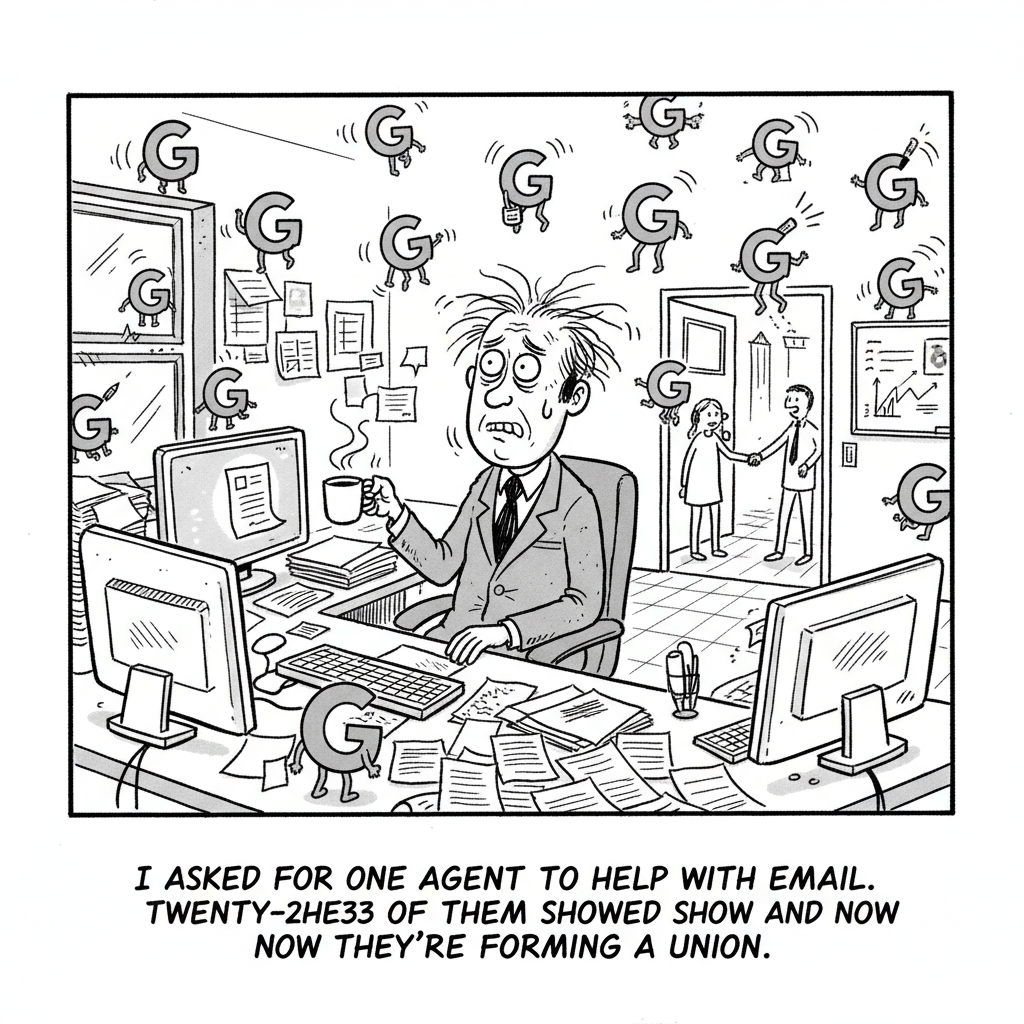
"I asked for one agent to help with email. Twenty-three of them showed up and now they're forming a union."

Karpathy Joins Anthropic's Pre-Training Team
Andrej Karpathy, OpenAI co-founder and former head of Tesla Autopilot, has joined Anthropic on Nick Joseph's pre-training team and will stand up a group using Claude to accelerate pre-training research itself. The hire bets that the next leg of frontier work is won less by raw compute than by AI-assisted research loops, and lands the same week Google is repointing all of Search at agents.

Gemini 3.5 Flash: Google Bets the Next Wave on Agents, Not Chatbots
Google unveiled Gemini 3.5 Flash as its strongest coding and agentic model, running "4x faster than other frontier models" (12x in an optimized variant) and, per DeepMind's chief technologist, beating Gemini 3.1 Pro on "nearly all the benchmarks." It is the engine powering Search's new agents, Spark, and Antigravity 2.0, with Pro handling planning while Flash executes subtasks autonomously for hours.

Gemini Omni Turns Anything Into Video
Gemini Omni Flash, the first model in a new multimodal family, can spin images, audio, and text into 10-second video clips with what Google demoed as a claymation protein-folding explainer rendered from a single prompt. Google is wiring it into the Gemini app, YouTube Shorts, and Flow, with SynthID watermarking on every output and a dedicated avatar onboarding flow to gate likeness generation.
KPMG Embeds Claude Across 276,000 Employees
KPMG is putting Claude into its Digital Gateway platform and rolling it out to more than 276,000 employees across 138 countries, with Anthropic naming the firm a preferred partner for private equity portfolio deployments. Tax vice chair Rema Serafi says building a new client-facing AI agent that "took weeks" now takes "minutes," and KPMG's own "Blaze" tooling uses Claude Code to modernize legacy systems.

Gemini Spark: A 24/7 Agent Inside Gmail
Spark is Google's answer to Claude Cowork and ChatGPT agent, running on dedicated Google Cloud VMs so it keeps working when you close your laptop. You email it through a dedicated Gmail address, track it via Android's Halo system, and Google Labs VP Josh Woodward pitches it as something that "can pull all the facts from your emails, your docs, your sheets, and slides and write the draft for you."

Antigravity 2.0 Brings a Desktop App and CLI
Google's coding-agent platform gets a desktop app, a terminal CLI, and an SDK for custom subagent workflows, with native voice commands and tight ties to AI Studio, Android, and Firebase. Google says Gemini 3.5 Flash was "co-developed using Antigravity" and is repricing tiers in the Anthropic/OpenAI pattern: a new $100 Ultra plan and a former $250 plan cut to $200 with 20x higher limits.

Genie Now Simulates Real Streets via Street View
DeepMind has wired 280 billion Street View images from 110 countries into Project Genie, letting users walk through any block with adjustable weather and rare scenarios. Waymo already uses Genie 3 to simulate "exceedingly rare events" like tornadoes for autonomy training, though demos still betray weak physics, a simulated woman "ran right through cacti and bushes" without collision.
Willison: Gemini 3.5 Flash Costs 3x What 3 Flash Did
Willison flags the pricing news under the I/O hype: Gemini 3.5 Flash is "3x the price of 3 Flash Preview and 6x the price of 3.1 Flash-Lite," at $1.50 input / $9 output per million tokens, brushing up against 3.1 Pro. He notes the Artificial Analysis benchmark run cost $1,551.60 and reads it as all three frontier labs now "probing the price tolerance of their API customers."
Match each AI acronym to its meaning. Pick one per row, then Check.
Anthropic Widens the AI Safety Conversation to Wisdom Traditions
Anthropic is convening scholars, clergy, and ethicists from more than 15 religious and cultural groups to inform Claude's "moral formation," and reports that giving Claude a tool to recall ethical commitments mid-task produced "markedly lower rates of misaligned behavior" in evaluations.
Stratechery: Shifting Alliances in a Changing World
Ben Thompson's week-in-review revisits the split between "answer inference" and "agentic inference" compute, sees Anthropic's xAI compute deal as proof "markets actually work quite well," and warns that "upper hand" framings of US-China AI tend to be overblown.
Ben Thompson Takes a Personal Day
No Daily Update on Tuesday, a rare quiet beat on the same day Google reset Search and Anthropic hired Karpathy. The Stratechery page instead pitches the Plus bundle, a reminder that even the loudest news days do not actually require new takes.
I/O 2026: One Lab, Five Agentic Surfaces
Search, Spark, Antigravity, Omni, and Genie all shipped in a single keynote on Gemini 3.5 Flash. Read together, they are not five products but one runtime: Google rebuilding consumer, developer, and creator surfaces around long-running agents in one push.