The era of cheap AI may be ending. As major providers including Microsoft and Anthropic push through steep price increases and lean harder on token-based billing ahead of expected public offerings, a once-unthinkable question is moving to the center of the industry: can the economics of generative AI actually hold? The fear, captured in the half-joking coinage "Tokenpocalypse," is that escalating compute costs and customer spending are on a collision course.
For two years the story of AI was capability. This is the story of the bill. Heavy users are watching per-token costs creep up just as agentic workflows, which consume tokens at a furious rate, become the default way to build. The reckoning is not whether the models are good enough. It is whether anyone can afford to keep running them at the volumes the technology now invites.
Product · OpenAI
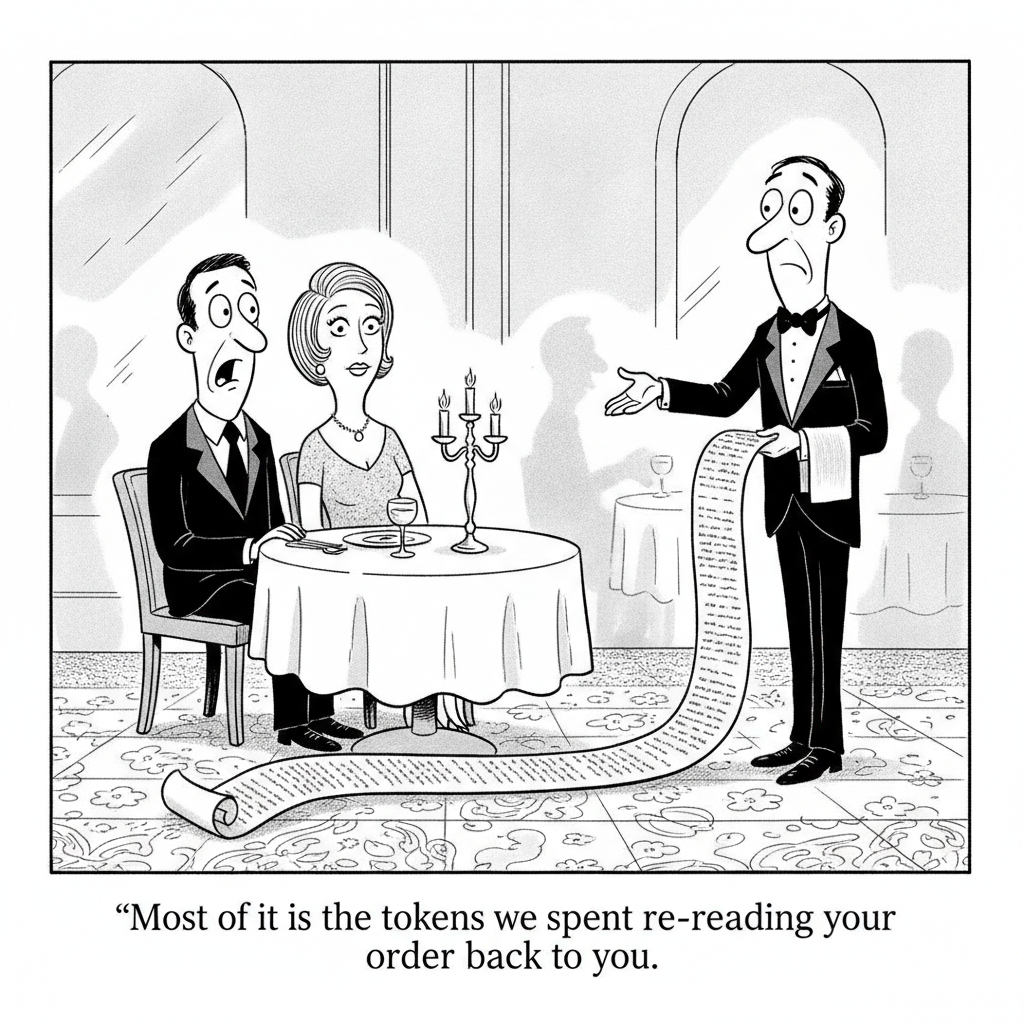
"Most of it is the tokens we spent re-reading your order back to you."
OpenAI plans to relaunch ChatGPT within weeks as a "super app" that bundles coding tools and AI agents into a single gateway, positioning it as a funnel toward paid products like Codex and a clearer path to profitability ahead of a possible IPO. The company is reportedly shelving several standalone 2025 products to concentrate on one unified platform built around a "personal agent" for both work and life, a strategy that squares it directly against Anthropic.
Ethan Mollick retires the "co-intelligence" framing of his last book and announces a successor, "Co-Existence," for a moment when AI agents are autonomous and "sometimes, but not always, better than you." He points to software development, where he cites Anthropic's claim that AI now writes 80% of its code, as the leading edge, and describes a strange new marketing reality: pitching the book to AI itself as the gatekeeper, building an AI-readable page and A/B-testing his message across models.
Gary Marcus argues that the surge of AI-generated content, from throwaway apps to scientific papers to books, is mostly low-value "slop" that has yet to translate into real economic return. He marshals studies from MIT, McKinsey, and Bain showing weak ROI and no measurable GDP lift despite the flood of output, making the bear case that volume is being mistaken for value. Read alongside the day's pricing anxiety, it is a pointed question: if the output is slop, who keeps paying the token bill?
Notion temporarily disabled its Claude-powered features early Sunday after detecting degraded performance and elevated failure rates, then restored service within roughly twelve hours. Anthropic called it "a brief infrastructure issue," but the episode is a reminder of how much of the productivity stack now depends on a single model provider staying up, and how quickly that dependency becomes visible when it does not.
The first alpha of datasette-agent-edit lands, providing abstract editing tools that other Datasette Agent plugins can build on to modify different kinds of content. It is a small but telling building block: infrastructure designed from the outset for agents, not humans, to be the ones doing the editing.
A report claims DeepSeek's new V4 Pro model edges out OpenAI's GPT-5.5 Pro on precision-oriented benchmarks, the latest signal that the open-weight challenger continues to close the gap at the frontier. Details on methodology and the specific benchmarks remain limited.
Word Search
Word Search
Click the first and last letter of each AI term hidden in the grid.
✦ The Big Picture
Microsoft quietly switched GitHub Copilot from a flat fee to metered, token-based billing, and the developer world flinched. Uber, by one account, torched its entire annual AI budget in about four months and started capping how many tokens its own employees could spend. That is the sound the industry made this week: not a model launching, but a meter starting to run. And once the meter is running, a question the era of free tokens let everyone avoid becomes unavoidable, is what these systems produce actually worth what it costs to produce it?
The Bill Comes Due
"Tokenpocalypse" is a pricing reckoning, not a tech failure. TechCrunch's Equity crew coined the term for the moment investor-subsidized AI economics get handed to customers. The core dynamic: "stuff that seems like it has no cost is, in fact, incredibly expensive," and labs marching toward IPOs can no longer eat the difference. ChatGPT Plus launched at "$20 a month" as a guess, not a strategy; now "tokenmaxxing" went from aspiration to disfavor "within six months." Unlike Uber, which could cut driver pay, AI firms face hard floors, compute, energy, chips, with little room to squeeze.
OpenAI's answer is to make the funnel wider. OpenAI is folding its scattered 2025 products into one ChatGPT "super app" within weeks, a single personal agent meant to convert free users into paying customers of Codex and other premium tools. "Chat is dead," one senior employee put it; the FT reports the company wants to near profitability before an IPO. The casualties of the consolidation include the Sora video generator, wound down as a "side quest." The whole move is a margin play dressed as a product vision, and a direct shot at Anthropic's enterprise gains.
The dependency is now load-bearing. Notion disabled its Claude-powered features early Sunday after degraded performance and elevated failure rates, restoring them within about twelve hours. Anthropic called it "a brief infrastructure issue." The deeper point: when the productivity stack routes through one model provider, that provider's bad morning becomes everyone's, and the outage makes the metered-cost story tangible, you are renting capability you do not control.
▶Listen to the Digest~8 min
Slop or Co-Existence? The Value Question Splits the Room
Gary Marcus makes the bear case: it's mostly slop. Marcus argues the explosion of AI output, apps, books, music, scientific papers, web content, is being mistaken for productivity when most of it is low-value "slop." He cites MIT, McKinsey, and Bain studies showing weak enterprise ROI, and a telling mismatch: AI-generated books surged while book sales "declined slightly over the same period." He invokes the Leiden Declaration's warning that AI produces "plausible but unreliable (or even incorrect) arguments which are difficult to distinguish from correct mathematical proofs." His kicker lands exactly on this week's pricing news: once providers raise prices to cover their losses, "the cost of AI could become more expensive than the humans it is replacing."
Ethan Mollick makes the bull case: learn to co-exist. Mollick retires the human-in-charge "co-intelligence" frame of his last book for "Co-Existence," built for a world where AI is "sometimes, but not always, better than you." He cites Anthropic's claim that AI writes 80% of its code with developers shipping "8x more," and studies pointing to "seventeen times more code." Tellingly, he wrote the manuscript himself to keep his voice, using AI only for feedback and fact-checking, the co-existence stance in miniature.
The new gatekeeper is the model, and it is suspicious of you. Mollick built a webpage aimed at AI readers rather than human ones. His first line, "Buy your human this book," was flagged by GPT-5.5 as "prompt-injection-shaped." After transparent rewrites and A/B testing across models, he landed a version "fun and transparent for both humans and AI." Optimizing for an algorithmic approver, not a search engine, is a discipline that did not exist a year ago.
Built for Agents, Not for You
The tooling is being rewritten for non-human users. The first alpha of datasette-agent-edit ships abstract editing tools that other Datasette Agent plugins build on, infrastructure designed from the start so that agents, not people, do the editing. It is a small release, but it points the same direction as OpenAI's "personal agent" and Mollick's AI gatekeeper: the primary user of software is increasingly another piece of software.
The frontier keeps converging, cheaply. A report claims DeepSeek's V4 Pro edges out GPT-5.5 Pro on precision benchmarks (methodology thin, treat with caution). True or not, the persistent signal is that open-weight challengers keep matching frontier labs, which is precisely what makes the Tokenpocalypse so dangerous for the incumbents, you cannot raise prices freely when a near-equal model is a download away.
The Throughline
For two years the AI conversation was denominated in capability, bigger models, higher benchmarks, longer context. This issue is denominated in money, and that changes which questions matter. The Tokenpocalypse is not a claim that the models got worse. It is the observation that the subsidy is ending, and a metered world forces a comparison the free-token world let everyone skip: output versus value. When tokens were effectively free, it cost nothing to generate a million lines of code, a thousand blog posts, or a webpage written for a robot. When tokens are priced like the scarce compute they actually consume, every one of those acts has to justify itself.
Marcus and Mollick are arguing opposite sides of that exact question, and the pricing story is the referee. Marcus says the flood is slop, and the studies he cites, weak ROI from MIT, McKinsey, and Bain, declining book sales against surging book production, are evidence that volume has been masquerading as value. Mollick says we are underestimating the systems, citing the 80%-of-code figure and the strange new labor of marketing to a model. Both can be right at once: AI can be genuinely better at writing code and still flood the world with content nobody values. What the Tokenpocalypse does is end the truce. If Marcus is correct that much of the output is slop, then metered pricing is the mechanism that exposes it, because slop is the first thing customers stop paying per-token to generate.
That is why the agent-first tooling and the model-as-gatekeeper stories belong here too. OpenAI's super app, datasette-agent-edit, and Mollick's AI-readable webpage all assume a future where software, not humans, is the main consumer of software, and where an agent's appetite for tokens is the cost center. The arXiv "Tokenomics" finding from yesterday's issue, that reviewing agent output eats more tokens than generating it, was the technical preview of today's financial one. Generation was always the cheap part. Verification, judgment, and the willingness to pay for either are the scarce inputs now, and the meter is what finally makes them visible.
The Bigger Picture
The AI industry is exiting the phase where growth was free and entering the phase where it has to be earned, token by token. Subsidized economics let a thousand experiments bloom and hid a brutal truth: a lot of what AI produces is not worth its marginal cost once that cost is real. The IPO filings coming from Anthropic and others will be the first time the public sees, in audited numbers, how each lab plans to close the gap between what compute costs and what customers will pay. That document, not the next model card, is the one that will move the industry.
The deeper risk is the inversion Marcus names. The entire investment thesis of generative AI is that it replaces expensive human labor with cheap machine labor. But if the only way to make the unit economics work is to raise prices until "the cost of AI could become more expensive than the humans it is replacing," the thesis eats itself. That pressure is exactly why DeepSeek's persistent frontier parity matters so much: a cheap, near-equal open-weight model is a permanent ceiling on what closed labs can charge, and a permanent floor under the question of whether the premium is justified.
So the field is sorting into two postures. One treats more output as more value and is about to discover, through metered bills and disappointing ROI studies, that volume without value is a liability. The other, the one Mollick is circling and OpenAI is monetizing, treats AI as a capable but untrusted partner whose work must be specified, supervised, and judged, and prices accordingly. The winners of the next two years will not be whoever generates the most. They will be whoever can prove, on an invoice, that what they generated was worth keeping.
What to Watch
The IPO filings. Anthropic's and OpenAI's eventual S-1-style disclosures will be the first hard numbers on AI unit economics. Watch for how they reconcile compute costs with customer pricing, that reconciliation is the whole ballgame, and it is about to stop being a guess.
Whether metered billing sticks. GitHub Copilot's flat-to-token shift is the test case. If developers tolerate it, expect every AI product to follow; if they revolt, labs will have to find margin somewhere harder. Either outcome reshapes how AI software gets priced.
The slop-versus-value evidence. Marcus is betting the ROI studies keep disappointing; Mollick is betting capability data keeps climbing. Watch the next wave of enterprise adoption surveys, they are the empirical scoreboard for which of these two is reading the moment correctly.