Your daily AI news digest
AI the News That's Fit to Prompt
Washington Unlocks Anthropic's Most Powerful Model, On Its Own Terms
The U.S. government lifted its block on Mythos, Anthropic's most capable model, clearing it for release to more than 100 American companies and federal agencies. The decision ends a roughly two-week standoff in which Washington had restrained the model over fears about its potential for misuse, a delay that left one of the frontier's sharpest tools sitting behind a government gate while the rest of the market moved.
What makes the moment notable is not just the release but the shape of it. Access was granted to a curated list, on the administration's say-so, rather than opened to the market. The same week, the White House moved to personally vet who can use OpenAI's newest model. The throughline is unmistakable: for the most powerful systems, the binding constraint is no longer engineering or even price. It is who holds the key, and a frontier model's distribution now runs through Washington.


"Turns out the moat wasn't the technology. It was the guy with the clipboard."
OpenAI Says the U.S. Government Will Vet Who Uses Its Latest Model
OpenAI will let the U.S. government approve who gets access to its newest model, GPT-5.6, after a Trump administration request narrowed the rollout to government-vetted partners. It is an extraordinary inversion of how software usually ships: instead of a public launch with a waitlist, the customer list is filtered through Washington. OpenAI has signaled it is uneasy with the precedent even as it complies, and paired with the Mythos release it marks the week government access control became a frontier-model feature, not an afterthought.

OpenAI Limits GPT-5.6, Says Restrictions Shouldn't Be the Norm
OpenAI confirmed it restricted its new GPT-5.6 lineup to a limited set of government-approved partners following a Trump administration request, while publicly arguing that this kind of restraint "shouldn't be the norm." The dual message, comply now, object on principle, captures the awkward position frontier labs find themselves in as national-security review starts attaching itself to ordinary product launches.

Asian Labs Rush Out Mythos-Like Models as the Export Ban Drags On
With Anthropic's most powerful models still walled off by U.S. export rules abroad, Asian challengers are filling the gap: China's 360 unveiled Tulongfeng and Tokyo's Sakana AI launched Fugu, both pitched as alternatives to the export-banned Mythos and Fable 5. It is the predictable second-order effect of export control, restricting the frontier at home accelerates the race to reproduce it everywhere else.

Anthropic's Economic Index Finds AI's Daily and Weekly Rhythms
Anthropic's latest Economic Index zooms into the clock, showing how Claude usage tracks the rhythm of work and life: personal tasks peak on weekends while work queries cluster in business hours. Drawing on new hourly-level methodology and a survey of 9,700 users, it links those usage patterns to people's expectations about their own jobs, a rare empirical look at how AI is actually folded into the day.
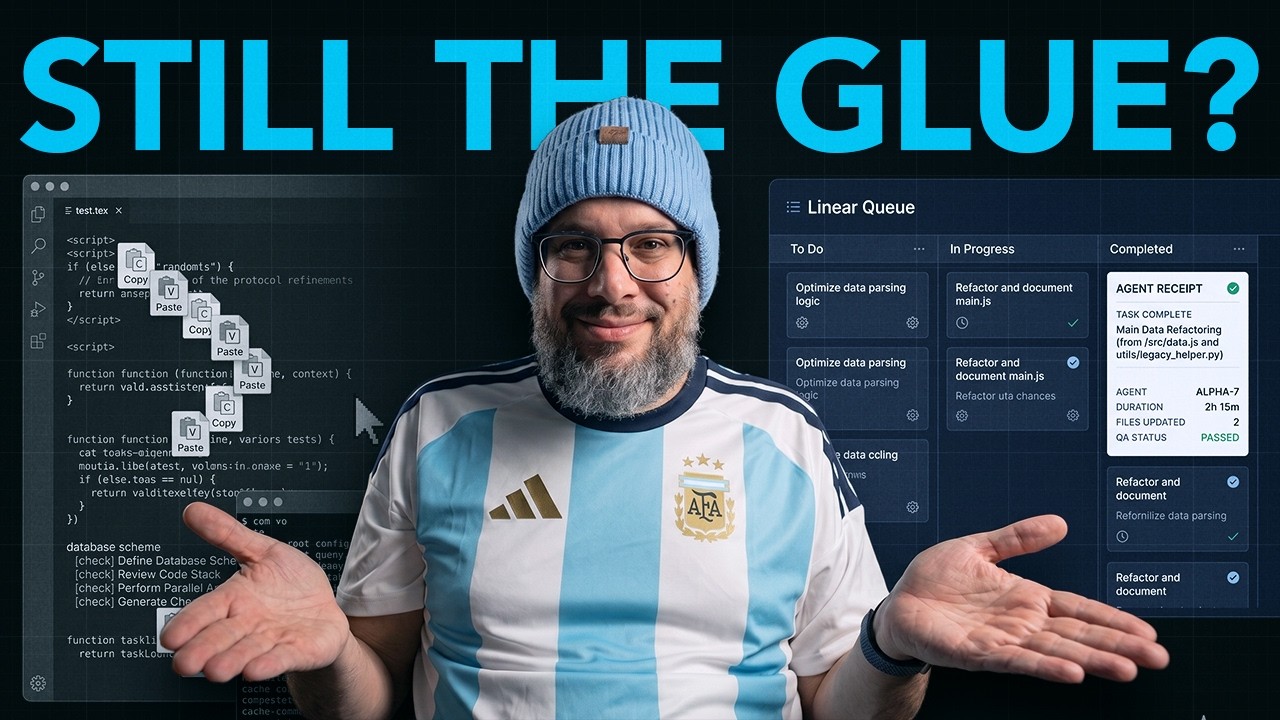
"I Was the Only Thing Connecting Claude, ChatGPT, and Codex"
Nate B. Jones argues that the human is quietly doing the worst job in modern AI work: acting as the hallway, hand-carrying context between Claude, ChatGPT, and Codex. So he built a replacement, an open engine with shared state, claim-locks, and receipts that lets agents hand off to each other and to a human only where judgment is required. The study guide breaks down the five components and the "stop being the glue" thesis.
Use These 17 Claude Plugins to Get 10x Better
Chase AI runs through 17 plugins, skills, and CLIs that turn Claude Code into a full workbench, grouped into design, productivity, and data. The study guide catalogs each one, from a taste-and-design skill stack to ponytail's productivity metrics, Firecrawl and Supabase CLIs, and a RAG setup, so you can cherry-pick what fits your workflow.

What It Means to Be a Mathematician When AI Does the Math
As AI systems get better at formal reasoning and proof, mathematicians are wrestling with a question that used to be hypothetical: if the machine can do the math, what is the human for? The piece surveys the field's split between those who see a powerful collaborator and those who fear obsolescence, and lands on the durable answer, that the purpose of mathematics was never only to produce proofs.
OpenAI Poaches Uber's India Chief to Run Its Biggest Market Outside the U.S.
OpenAI named Prabhjeet Singh, former president of Uber India and South Asia, as its first managing director for India, a market it now calls its second-largest after the United States. The hire signals that the consumer-AI land grab has moved past product into distribution and on-the-ground operations, with India the prize.
The Month Generative AI Lost Its Mojo
Gary Marcus argues June 2026 was an inflection point where generative AI's momentum stalled, pointing to a delayed OpenAI IPO, a broad sell-off across AI-exposed stocks, and mounting doubts about profitability and reliability. Read alongside a week of government gatekeeping and export workarounds, his bearish case is a useful counterweight: the question is shifting from how fast AI can advance to whether the business underneath it pencils out.
A Frontier Open-Source Model Will Arrive December 3, 2026, This Analysis Says
Doubleword crunches the gap between open- and closed-source models and finds the answer depends entirely on how you measure: one headline metric predicts the gap closing by December 3, 2026, but average across 18 benchmarks and it holds stubbornly steady at about five months behind. A timely reminder, in a week of export bans and access gates, that "open" is the pressure valve everyone is watching.
Trump Admin Clears Mythos for 100-Plus Companies and Agencies
TechCrunch confirms the administration authorized Anthropic's Mythos for use by more than 100 U.S. companies and federal agencies, reversing a two-week ban.
OpenAI Previews GPT-5.6 Sol
OpenAI teased GPT-5.6 "Sol," the next step in its GPT-5 line, the model now at the center of the government-vetting debate.
White House Will Ad Hoc Decide Who Gets GPT-5.6
Zvi Mowshowitz dissects the shift to case-by-case White House approval for frontier-model access, and why opaque, discretionary gatekeeping worries him.
DeepSeek Open-Sources DeepSpec for Speculative Decoding
DeepSeek released DeepSpec, a full-stack codebase for training and evaluating draft models that speed up inference via speculative decoding.