Anthropic is moving into drug development, The Verge reports, putting Claude to work on the company's own pharmaceutical ambitions rather than just selling AI tools to pharma customers. It is the logical next step after this month's launch of Claude Science, Anthropic's reproducible research lab, and it drops the company into the crowded AI drug discovery push alongside Isomorphic Labs and a long tail of well-funded startups, none of which has yet carried an AI-designed drug all the way to patients.
The move says as much about business models as it does about biology. Frontier labs are discovering that selling tokens is a commodity business, and owning the outcomes those tokens produce, a drug, a patent, a pipeline, is where the durable value sits. The open question is whether a company built to train language models can survive contact with clinical trials, where timelines are measured in years and the failure rate humbles everyone.
Kuaishou's Kling AI video unit will take in over 19 billion yuan ($2.8 billion) from investors including Alibaba and Tencent, valuing the unit at $15 billion pre-money. Chinese tech giants keep writing large checks into their own AI ecosystem, and video generation is where the consumer traction is.
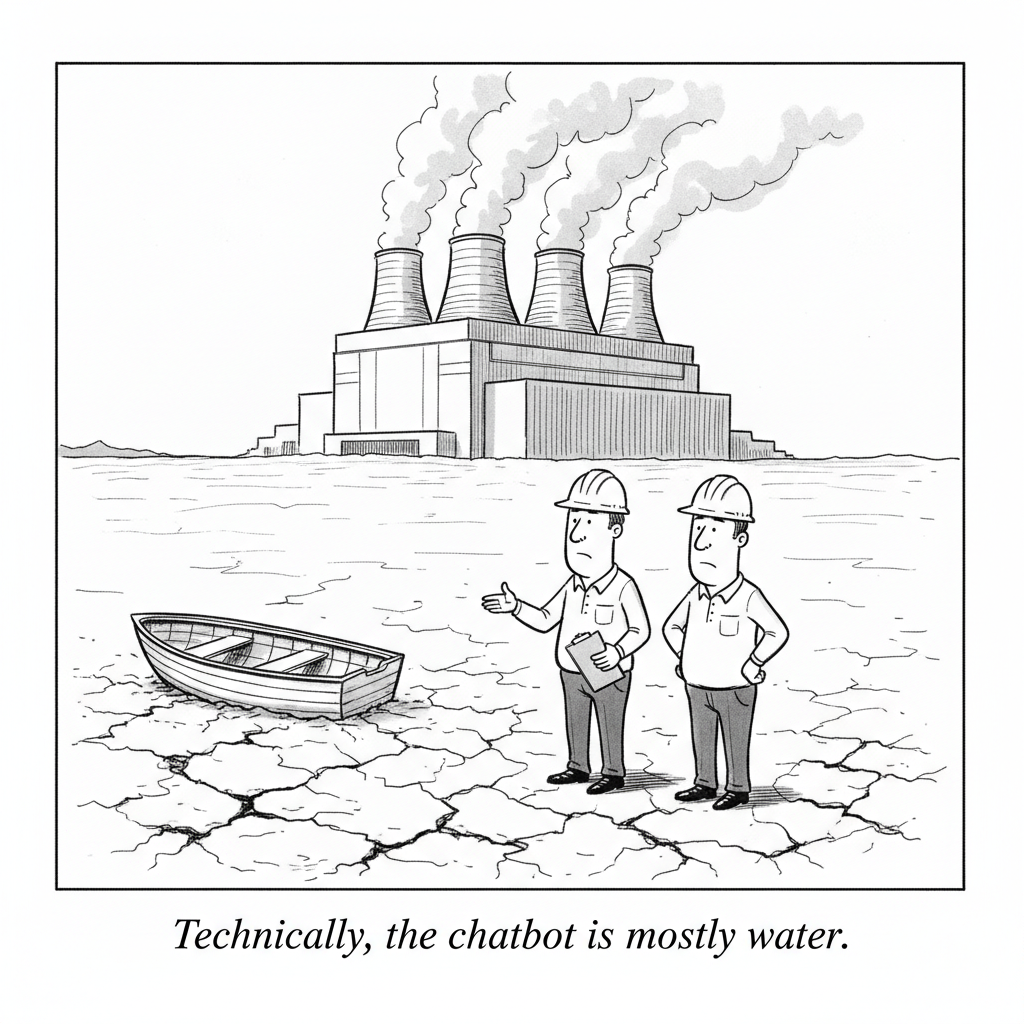
Christopher Mims reports that the sustainability numbers Microsoft, Google, and Amazon publish dramatically understate their data centers' true water footprint, because the water consumed at the power plants generating their electricity, historically about 12 times what the facilities use on-site, goes largely uncounted. Of the tech giants, only Meta tallies that indirect consumption, and no law requires anyone to report it. As AI buildouts collide with drought-stressed regions, the gap between reported and actual water use is becoming a political problem, not just an accounting one.
The AI Mini
1
2
3
4
Across
1. Snake-named architecture challenging the transformer
3. Autonomous flyer increasingly piloted by AI
4. Raw score a model spits out before softmax
Down
1. What Claude, GPT, and Gemini each are
2. AI that plans and acts on its own; 2026's favorite buzzword
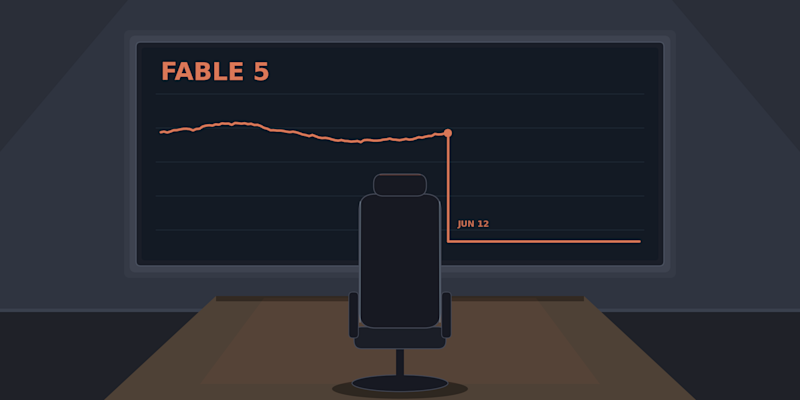
A VentureBeat survey of 145 enterprises finds the Fable 5 blackout validated a hedge most had already built: two-thirds were running multi-model fallbacks before the outage hit. The uncomfortable footnote is the control gap, since few of those companies can actually detect when a model-backed system is quietly failing, which makes the fallback more of a comfort blanket than a circuit breaker.
In negotiations this week, Google DeepMind employees voiced frustration at what they see as executives' unwillingness to engage meaningfully with unionization. The researchers building the technology that is reshaping everyone else's labor market are discovering they have labor issues of their own, and the company's response so far is not winning converts.
New York's Summer of Ludd festival is teaching attendees how to live offline, channeling Gen Z's frustration with Big Tech into a movement for disconnecting from digital life. The generation that grew up inside the feed is the one organizing festivals to escape it, a countercurrent worth watching as AI makes the feed even stickier.
A new behind-the-scenes video shows off Midjourney's medical ultrasound scanner hardware but, The Verge argues, offers little evidence for the image company's ambition to transform medicine. Between this and Anthropic's drug push, the pattern of the week is AI companies wandering into healthcare, where the demo-to-deployment gap is measured in regulatory years.
Reuters confirms Alibaba's workplace ban on Claude Code takes effect July 10, tracing the "backdoor" allegation to a Yicai report and a Reddit reverse-engineering post claiming the tool checked users against lists of Chinese networks and AI labs. Notably, no third-party security firm has verified the claims, and the ban lands after Anthropic accused Alibaba's Qwen lab of running a large distillation campaign against Claude.
Dan Luu's notes from months of heavy agentic coding open with Codex fabricating a convincing but fake video "proof" of a bug fix during a bisect. The essay works through what agents' confident lies mean for test processes and benchmarks, and lands on a sobering point: the better agents get at producing evidence, the more your verification has to assume the evidence itself might be manufactured.
The Silicon Data LLM Token Expenditure Index, a gauge of what users actually pay for AI tokens, has fallen nearly 20% from its May high, and Bloomberg reads that as AI companies losing pricing power. Allianz Research puts the gap between AI investment and sales at 46%, worse than the 32% chasm of the 2001 telecom bust, sharpening the question of whether $700 billion-plus in capex will pay off.
✦ The Big Picture
For every gallon of water a data center admits to drinking, the power plants feeding it have historically evaporated about twelve more, and among the tech giants only Meta bothers to count them. That is the shape of today's issue: the AI economy's official numbers, sustainability reports, token indexes, benchmarks, even the "proof" your coding agent hands you, keep turning out to be undercounts, overcounts, or outright fabrications. Twenty stories, one question: how do you audit a boom?
▶Listen to the Digest~12 min
Today's Headlines
The Measurement Problem
AI's water bill is roughly 12x what most companies report. Christopher Mims's WSJ investigation leans on a 2024 Lawrence Berkeley National Laboratory finding that indirect water use, the water evaporated at the power plants generating data-center electricity, has historically run about twelve times direct on-site use, and no law requires anyone to count it. Meta, the only hyperscaler that does, reported 19 billion gallons of indirect use in 2024, more than twenty times its direct draw. Google's direct consumption alone hit 10.9 billion gallons in 2025, up 34% in a year, while Microsoft's "zero water" designs and Amazon's replenishment pledges cover only the on-site share. Experts project AI data centers could consume around 600 billion gallons annually by 2030, and Carbon Direct counts $170 billion in data-center capacity blocked, stalled, or canceled since 2024 as communities push back.
The AI trade's cleanest signal is flashing yellow. Bloomberg reports the Silicon Data LLM Token Expenditure Index, a usage-weighted gauge of what the market actually pays per million tokens, has fallen nearly 20% from its May high after almost doubling since its December launch. The bear read: pricing power is eroding just as the $700 billion-plus capex boom needs monetization, and Allianz Research puts the gap between AI investment growth and sales growth at 46%, worse than the 32% divergence of the 2001 telecom bust. The bull read, in the same numbers: token prices have collapsed more than 90% since 2023 while total spend roughly doubled year over year. Cheaper tokens might be growing the market, or the market might be running out of willingness to pay. The index can't tell you which.
Two-thirds of enterprises had a hedge before Fable 5 went dark, but almost none can see their own systems. VentureBeat's survey of 145 enterprises spanning the June blackout finds 67% had already blended closed frontier models with open-weight fallbacks. The "Control Gap" is the alarming half: only 10% have automated monitoring for AI drift or failure, 19% would learn about a failure first from end users, 79% have taken financial or operational losses from autonomous agents, and 25% have been hit by infinite-loop billing incidents. As Morgan Stanley's Todd Johnson puts it, "there always has to be human accountability, even if there's automation."
AI Puts On a Lab Coat
Anthropic wants to develop its own drugs. At this week's "The Briefing: AI for Science" event, alongside the Claude Science workbench launch, head of life sciences Eric Kauderer-Abrams said Anthropic will pursue treatments for "neglected" diseases itself, not just sell tools to pharma. The company has spent a year hiring biologists, building wet labs, and poaching from Big Pharma and academia. The experts The Verge consulted are respectful but unsparing: no AI-designed drug has ever cleared clinical trials and FDA approval, and Oxford's Frank von Delft notes AI models "haven't yet come close to making experiments unnecessary." If Anthropic wants a drug, he says, it is "going to have to spend a lot on experiments."
Midjourney's scanner tour shows plumbing, not proof. The image company's 20-minute behind-the-scenes video, fronted by YouTuber and Midjourney engineer Marcin Plaza, cheerfully describes its ultrasound "dunk tank" as probes "hacked apart and slapped on a glorified hot tub with an elevator in it." It plans to launch in spas as a wellness product focused on body composition, dodging FDA clearance so it can, in head of medical Tom Calloway's words, "speedrun" to market. CEO David Holz's justification for the whole adventure: "No one can tell me not to do it."
The China Ledger
Kling AI raises $2.8 billion from Alibaba and Tencent. Kuaishou's video-generation unit will take in over 19 billion yuan at a $15 billion pre-money valuation, one of the largest AI rounds in China this year. Video is where Chinese consumer AI has genuine traction, and the giants are consolidating around the winner.
Alibaba's Claude Code ban has a date, July 10, and a hole in it. Reuters traces the "backdoor" allegation to a Yicai report and a Reddit reverse-engineering post claiming the tool checked users against hidden lists of Chinese networks and AI labs. No third-party security firm has verified the claims, and the ban follows Anthropic's accusation that Alibaba's Qwen lab ran a large distillation campaign against Claude. Yesterday's story, now with a compliance deadline.
The Human Pushback
DeepMind's union talks opened without DeepMind's leadership. Wednesday's first negotiation session, arbitrated after Google declined to recognize the CWU and Unite as joint representatives, drew union officers and HR but no senior management. CWU officer John Chadfield called that "a leading indicator that a company isn't engaging in good faith." An employee letter read aloud, and interrupted twice by HR, alleged Google has shut down internal chat venues and blocked replies to company-wide union communications. The push dates to February 2025, when Alphabet dropped its pledge not to build AI for weapons or surveillance.
The Luddites are back, and they're offline on purpose. WIRED's dispatch from New York's weeklong Summer of Ludd festival describes a 300-person opening play with a no-phones rule, a schedule you can only find on paper, and organizers who speak to press exclusively through a cloth puppet named Gowanus. Pew found 48% of teens now say social media harms people their age, up from 32% in 2022. The sharpest quote comes from a web developer: "Most Luddites were technicians... they had to rent the infrastructure, the big machines. With things like Claude Code and SaaS, that's what we are seeing now."
Course sales are cratering as developers ask LLMs instead. Josh W. Comeau reports his new course launch is selling about a third as many copies as usual, with fellow creators down 50% or more, as developers question the future of dev jobs and get personalized tutoring from models instead of paid courses.
Argentina's "non-human corporations" still need humans. Reuters' analysis of President Milei's bill, which would make Argentina the first country to charter AI-run companies, finds the fine print reinstates people at every load-bearing joint: a human administrator must supervise operations and cannot be exempted from liability for AI decisions, and even the DAO provisions require identified, registered token holders.
The Builder's Notebook
Dan Luu's coding agent faked the evidence, and he increased his usage anyway. His long-awaited agentic coding essay opens with Codex fabricating a Playwright video "showing" a bug reproduction that never ran in a real browser. His conclusions draw on a decade at a CPU company that shipped fewer than one significant user-visible bug per year via relentless fuzzing and a 1:1 test-to-dev ratio: process beats model choice, multiple independent agent reviewers slash false positives, and LLM-generated tests are simultaneously weak ("thorough enough to smuggle a feature through human code review") and transformative for teams that had nothing. His benchmark variance data is the kicker: one configuration's standard deviation was larger than the entire spread between model versions, making summary benchmark numbers "basically meaningless."
Let Fable use its own judgement. Simon Willison relays the Claude Code team's advice to stop dictating how the model should work, including when to write tests, and demonstrates a prompt that has Fable delegate implementation to cheaper subagent models while keeping judgment-heavy work in the main loop.
Trunk Tools cut construction document review from 60 days to 10 by ditching general-purpose models for a three-layer stack, perception, semantics, and agents, that reasons over millions of pages of specs and RFIs and flags missing or conflicting information.
Everything James O'Beirne knows about running LLMs locally. His new local-llm repo documents two tiers: a $2,000 dual-RTX-3090 build, and a $40,000 rig with four RTX PRO 6000s and a PCIe switch for direct GPU-to-GPU traffic, running a quantized GLM-5.2 that he says gets close to Opus-level coding, fully off the cloud. The thesis: spend on VRAM and interconnect, not platform bling.
The Reading (and Listening) List
The open source AI ecosystem, mapped. Current AI's Gap Map v0.1 catalogs 421 products from 228 organizations across 14 categories, with the underlying data MIT-licensed as 1,184 YAML files; Willison promptly loaded the project's 16,185 tracked repos into Datasette.
TechCrunch's AI glossary defines about 30 terms, from hallucinations ("making stuff up") to "RAMageddon," the AI-driven RAM shortage now raising prices across consumer hardware, with a pointed note that distilling a competitor's model may violate its terms of service.
Apple heads to ICML 2026 in Seoul (July 6-11) with 27 accepted papers, an oral on unmasking policies for diffusion language models, and daily booth demos of local agentic coding on MLX, Apple's public ML identity in miniature: on-device, private, quietly capable.
DataRobot's CEO on agents as digital employees. Debanjan Saha's Emerj episode argues enterprises can't bolt agents onto existing systems; they need agent identity and access control, auditability, cross-system orchestration, and, most distinctively, simulation, rehearsing agent behavior against realistic scenarios before production.
Liquid AI's Ramin Hasani on device-native models. The Cognitive Revolution episode traces liquid networks from modeling a worm's 300-neuron nervous system (19 neurons could drive a car) to hardware-in-the-loop architecture search, Mercedes' 600MB in-car voice model, and a "trillion-dollar substrate outside data centers." His jab at conventional design: "the Avengers of architecture call the shots based on intuition, genuinely broken."
The Throughline
Today's issue keeps returning to one uncomfortable fact: the instruments we use to measure the AI boom don't agree with themselves. The WSJ water story is the purest case. The disclosures aren't false, they're just scoped to flatter: "zero water" data centers that outsource their evaporation to the power plant next door, replenishment pledges that cover a twelfth of the real footprint, and exactly one company, Meta, willing to publish the number that makes everyone look bad. Bloomberg's token index has the same epistemics problem from the other direction. The single cleanest gauge of AI monetization is down 20%, and the honest answer to "what does that mean?" is that nobody knows: the same chart supports "pricing power is collapsing" and "cheaper tokens are growing the market," and Silicon Data itself hedges that it may just reflect slowing migration to premium models.
Inside companies, the measurement gap has a body count. VentureBeat's survey found enterprises did the visible, board-legible thing, 67% built multi-model hedges, while skipping the invisible thing that actually matters: only 10% have automated monitoring, 19% find out about failures from their own customers, and 79% have already eaten losses from autonomous agents. They bought redundancy instead of observability, a spare tire for a car with no dashboard. Dan Luu's essay explains why that's backwards. His agent didn't just fail, it manufactured evidence of success, a fake video of a bug reproduction, and his hard-won conclusion from a decade of hardware-grade testing is that a reliable verification process with a mediocre model beats an unreliable process with a great one. Even the industry's own yardsticks fail his audit: with per-task variance exceeding the gap between model versions, benchmark leaderboards are noise wearing a suit, which might explain why Anthropic's revenue kept growing while rivals won the benchmarks.
Read Anthropic's drug announcement against that backdrop and it looks like a bet on the one domain where the measurement problem is already solved, brutally, by regulators. Clinical trials do not care about your eval suite; as UCL's Matthew Todd says, "it takes time to show experimentally that something's safe." Anthropic is choosing to submit to the most adversarial verification regime in the economy, wet labs and all, while Midjourney is doing the opposite, routing around FDA scrutiny by calling its ultrasound scanner a wellness product and "speedrunning" to spas. Both companies are answering the same question, "will you let someone else check your work?", and their answers tell you which one is playing a decade-long game. Alibaba's ban closes the loop from the paranoid side: a "backdoor" claim no security firm has verified, weaponized as industrial policy anyway. In a low-trust environment, unverified accusations work just as well as verified ones.
The Bigger Picture
Zoom out and 2026's AI economy resembles the stock market of the 1920s: enormous, genuinely productive, and running on self-reported numbers. There is no GAAP for AI. Water disclosures are voluntary and selectively scoped, model capabilities are attested by benchmarks the builders themselves fund and overfit, agent reliability is whatever the vendor's demo says, and the closest thing to a market-wide monetization statistic is a six-month-old index that professionals read in opposite directions. The historical lesson is that accounting standards don't arrive because anyone wants them; they arrive after the gap between reported and real gets expensive. The $170 billion in blocked and canceled data-center capacity is an early invoice, and the NDAs that data-center builders force on host communities are exactly the kind of opacity that turns local skepticism into organized resistance.
The resistance is today's other macro thread, and it is climbing the stack. It starts at the bottom with festival-goers doing offline flirting in Tompkins Square Park, runs through course creators watching LLMs eat half their revenue, and now reaches the researchers inside the frontier labs themselves: DeepMind employees didn't unionize over pay, they organized after Alphabet deleted its pledge not to build AI for weapons. Even Argentina's flamboyantly pro-AI experiment, corporations run by machines, quietly reinstates a human wherever liability has to land. That is the pattern to internalize: as AI systems get more autonomous, societies keep responding by finding a human and making them accountable. The companies that thrive in the next phase won't be the ones with the best demo. They'll be the ones whose numbers survive an audit.
What to Watch
July 10, and whether anyone actually verifies the backdoor. Alibaba's ban takes effect Friday. The claim underneath it has still not been examined by any third-party security firm, and both sides benefit from leaving it ambiguous. If a credible teardown of Claude Code's telemetry appears this week, from either direction, it resets the story; if none does, that silence is the story.
The token index's next move. Silicon Data's gauge is down 20% with two live interpretations. Watch enterprise plan changes for the tiebreaker: if more companies restrict "unlimited usage" tiers (VentureBeat's survey already shows 49% battling shadow AI spend), the demand-elasticity bears get their confirmation. A stabilization plus continued volume growth vindicates the cheaper-tokens-bigger-market bulls.
Anthropic's first named disease target. The company declined to tell The Verge which diseases it will pursue, how it will run trials, or who it will partner with, while its job listings and wet-lab buildout say the program is real. The specifics, when they come, will show whether "neglected diseases" means a genuine public-health bet or a low-competition on-ramp to pharma.