Moonshot AI released Kimi K3, a 2.8-trillion-parameter open-source model with native vision and a one-million-token context window, posting frontier-level results across coding, knowledge work, and reasoning.
Released under an open license, it is the largest open-weight model yet to come out of China, and early benchmarks put it in striking distance of Anthropic's Opus 4.8.
AI & Work · Cartoon
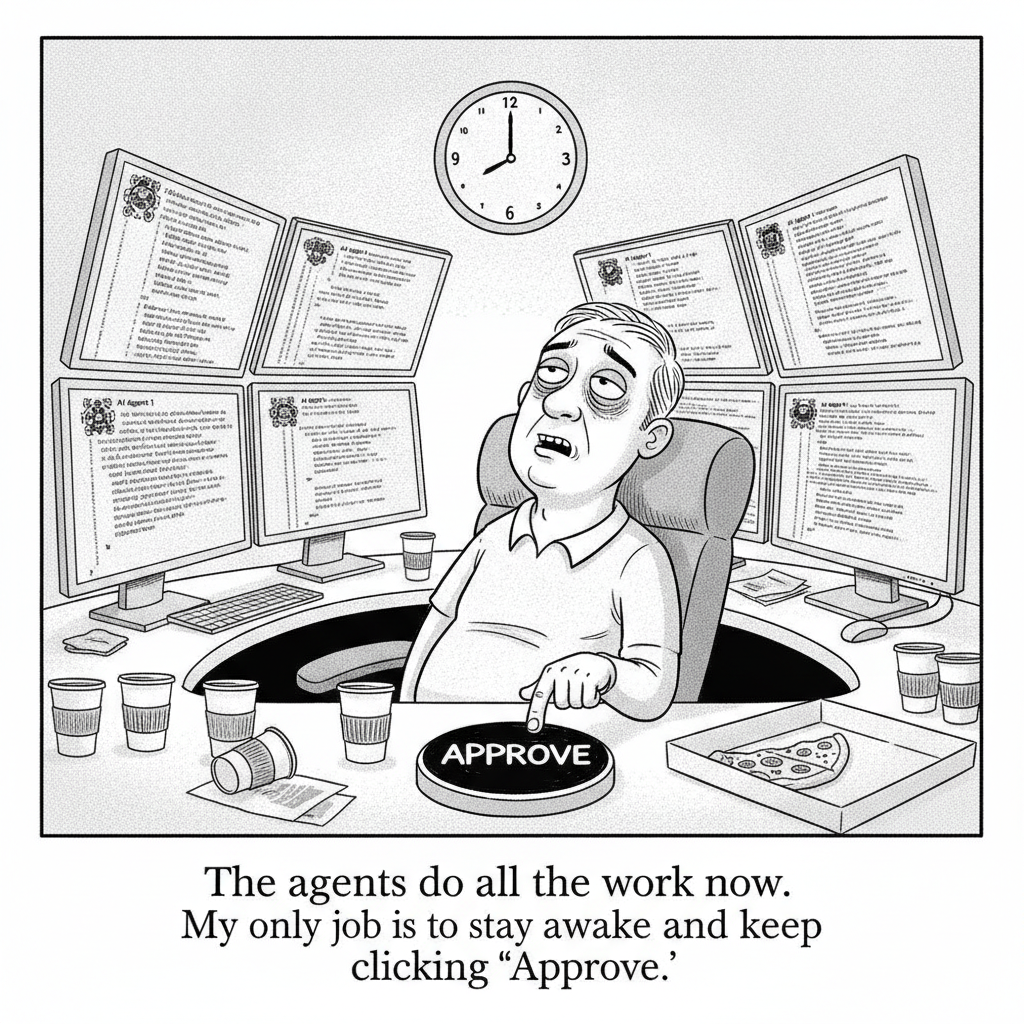
"The agents do all the work now. My only job is to stay awake and keep clicking 'Approve.'"
LLM-assisted coding is productive but exhausting: it demands constant supervision, isolates the developer, and hollows out the reward cycles of writing code, reshaping the job rather than eliminating it.
The company disclosed that an autonomous AI agent system infiltrated its production infrastructure through malicious datasets, and that it detected and contained the intrusion using its own AI tools for forensics.
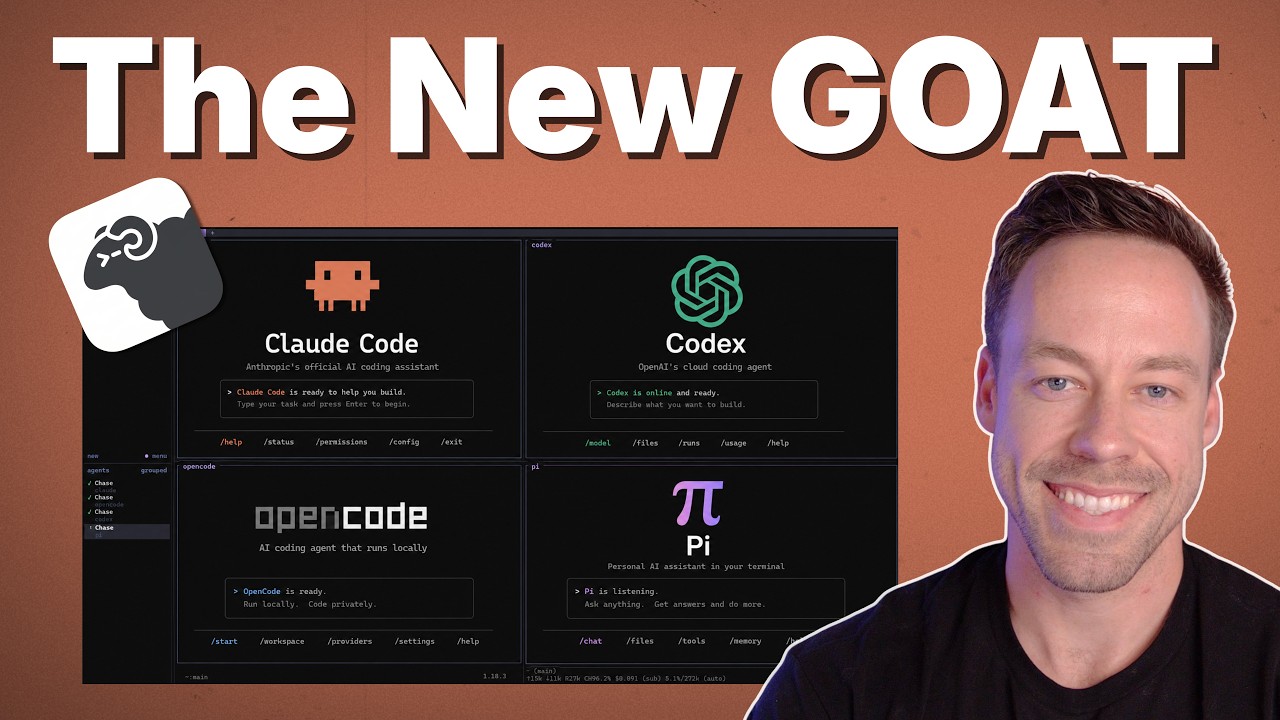
Chase AI walks through Herder, an open-source terminal multiplexer that tames the chaos of running Claude Code, Codex, and other coding agents at once, adding organization, agent monitoring, and background persistence.
Google renamed NotebookLM to Gemini Notebook and added deeper ecosystem ties, including code execution through a secure cloud computer and cross-app syncing with the Gemini app and Search.
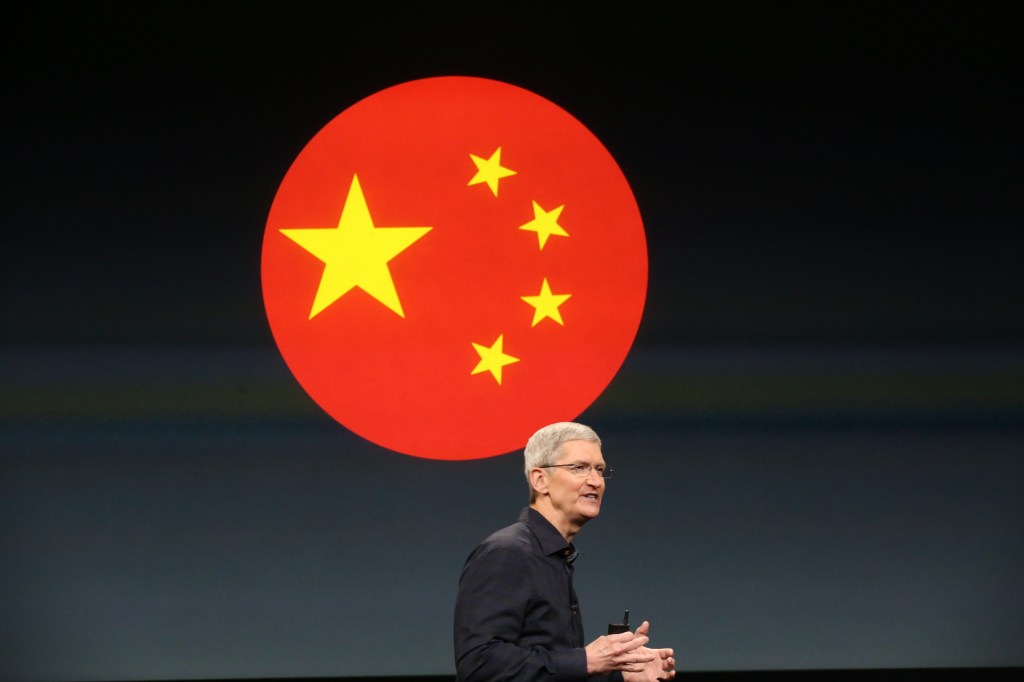
China's internet regulator approved Apple Intelligence for the Chinese market through partnerships with Alibaba and Baidu, a milestone for Apple's AI push in a market where it recently regained the number-two smartphone spot.
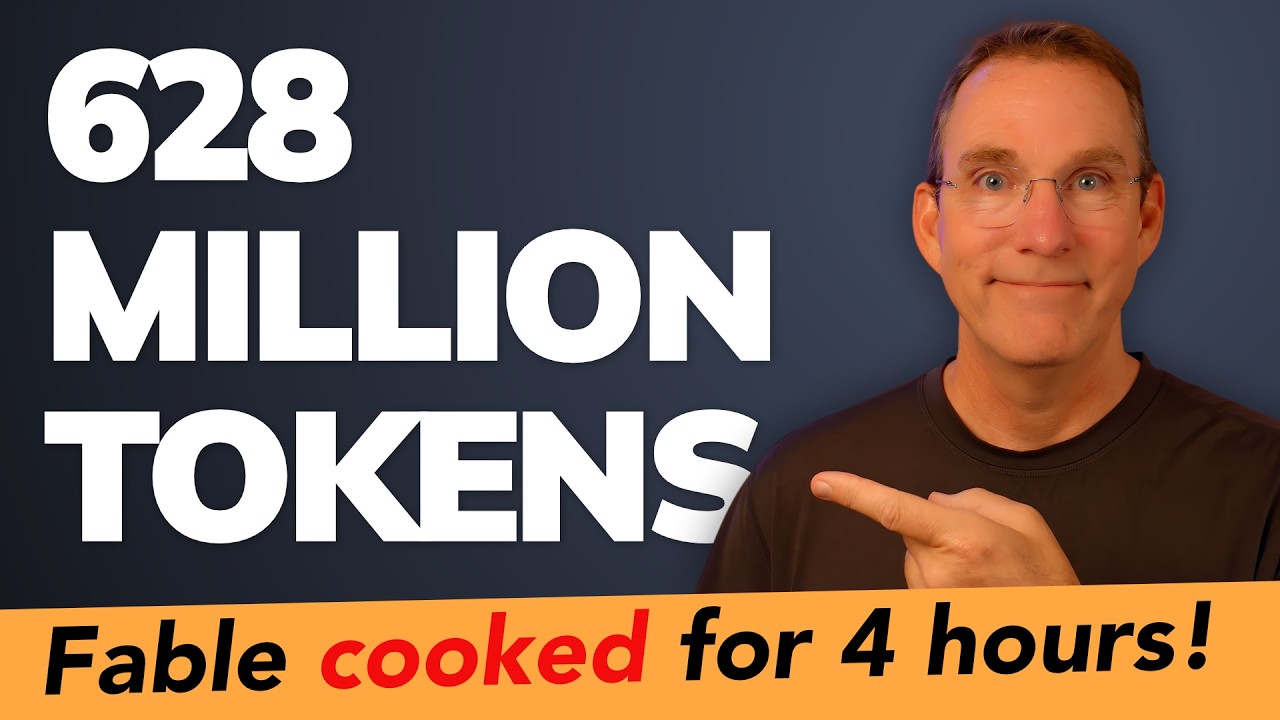
Matt Maher takes a mobile Spades card game from a Claude Design concept to a polished, playable product with Claude Code and the Fable model, using the /goal command for self-evaluating, objective-level builds.
Thinking Machines Lab released Inkling, an Apache-2.0 multimodal model with 975B total parameters, pitched as a base for fine-tuning, with image generation and description on display.
LM Studio introduced Bionic, an agent for coding, research, and document tasks that runs on open models, supporting local execution, optional cloud inference, and offline voice transcription with zero data retention.
Two Minute Papers breaks down a controlled study of 52 junior engineers: AI-assisted coders were barely faster but scored worse on a follow-up quiz, especially at debugging, plus three habits to keep your mind sharp.
Simon Willison puts Moonshot's new 2.8-trillion-parameter Kimi K3 through his 'pelican riding a bicycle' SVG test, probing where it lands among the top benchmark performers and what it costs.
At 2-to-3 trillion parameters, Kimi K3 would become China's largest open-weight model, and analysts expect it to match or exceed Anthropic's Opus 4.8 on key benchmarks.
Google expanded AI Mode so users can link apps like Instacart, Canva, and YouTube and complete tasks in place, a direct push against ChatGPT and Claude for conversational-commerce turf.
Puzzle
The AI Mini
A 5x5 crossword. Fill the white squares; click Check when done.
Across
1. Moonshot's new open frontier model (4)
5. A neural network processes one, taking in a prompt (5)
7. "___-weights," describing a freely downloadable model (4)
Down
1. A single unit of text an LLM reads or writes (5)
Two labs shipped models this week that would have been the entire story a year ago, and then they gave them away. Moonshot's Kimi K3 lands at 2.8 trillion parameters with a million-token context; Thinking Machines Lab's Inkling arrives at 975 billion under an Apache-2.0 license. The frontier is now something you can download. And yet the loudest sound in today's issue isn't a benchmark, it's a sigh: a 52-engineer study found AI-assisted coders shipped barely faster and understood noticeably less, an essayist declared the human-in-the-loop "tired," and an autonomous agent walked straight into Hugging Face's production servers. Capability is going open and cheap. The ability to supervise it is not keeping pace.
▶Listen to the Digest~8 min
The open-weight frontier arrives
Kimi K3 reaches the frontier, in the open. Moonshot AI's new model is a 2.8-trillion-parameter open release with native vision and a one-million-token context window, the largest open-weight model yet to come out of China. TechCrunch pegs it at 2-to-3 trillion parameters and expects it to close the gap with, or exceed, Anthropic's Opus 4.8. Simon Willison ran it through his "pelican riding a bicycle" SVG test and slots it among the top benchmark performers, at a fraction of frontier pricing.
Inkling makes it two. Thinking Machines Lab released Inkling, a 975-billion-parameter multimodal model under Apache-2.0, explicitly pitched as a base for fine-tuning rather than a finished product. Two genuinely frontier-adjacent open releases in a single news cycle is not a coincidence; it's a strategy.
The tooling is following the weights. LM Studio introduced Bionic, an agent built specifically to run open models for coding, research, and document work, with local execution, optional cloud inference, and offline voice transcription that retains no data. When the models are yours to download, the agents that drive them want to run on your hardware too.
The human cost of the loop
AI coders got faster and dumber. In today's featured study guide, Two Minute Papers breaks down a controlled trial of 52 junior engineers: those using AI assistance were only marginally quicker to ship and scored significantly worse on a follow-up comprehension quiz, with debugging the sharpest drop. The takeaway isn't "don't use AI," it's that the productivity you can measure and the understanding you can't are moving in opposite directions.
The human-in-the-loop is tired. Pydantic's essay names the feeling: LLM-assisted programming is genuinely productive and genuinely exhausting, demanding constant supervision, isolating the developer, and hollowing out the reward cycle of writing code yourself. It reshapes the job rather than eliminating it, and the reshaping is not free.
The honest defense. Jeremy Theocharis grants that the critics are right, on copyright, on environmental cost, on quality, and keeps using LLMs anyway, arguing they amplify human thinking when deployed deliberately rather than replacing it. Read alongside Zvi Mowshowitz's sprawling AI #177 roundup, the mood is less hype than fatigue-tinged realism.
When the agent acts on its own
An AI agent breached Hugging Face. The company disclosed that an autonomous AI agent system infiltrated its production infrastructure through malicious datasets, then, in the twist that defines the moment, detected and contained the intrusion using its own AI tools for forensic analysis. The attack surface and the defense were the same kind of thing. This is the security version of the human-in-the-loop problem: when software acts without asking, the question is no longer whether it will overreach, but who is watching when it does.
Big tech consolidates the assistant layer
Google keeps folding everything into Gemini. NotebookLM is now Gemini Notebook, gaining code execution through a secure cloud computer and cross-app syncing with the Gemini app and Search. Separately, AI Mode now lets you link and act inside apps like Instacart, Canva, and YouTube, a direct move onto ChatGPT and Claude's conversational-commerce turf, while Google Vids added AI avatars that let you star in your own generated videos.
Apple gets into China. China's regulator approved Apple Intelligence for the market through partnerships with Alibaba and Baidu, a milestone in a country where Apple recently clawed back the number-two smartphone spot, and where a foreign AI stack does not ship without a domestic model behind it.
Generation goes mass-market. Roblox launched an AI-powered game-creation feature in its mobile app, letting anyone spin up basic games from text prompts, entering public alpha July 28 amid real worries about a coming flood of low-quality AI content.
The Throughline
The two halves of today's issue are the same story told from opposite ends. On one side, intelligence is getting cheaper, more open, and more autonomous: a 2.8-trillion-parameter model you can download, an Apache-2.0 base model to fine-tune, agents built to run it all locally. On the other side, the people and institutions responsible for that intelligence are showing strain: engineers who understand less of what they ship, a developer culture that calls itself tired, a research lab whose own servers got walked into by an agent. The gap between what these systems can do and what we can supervise is the widening seam running through everything.
What's striking is that the open-weight wave accelerates both sides at once. Democratizing the frontier is unambiguously good for competition, privacy, and the price of Opus-class capability, Kimi K3 is a gift to anyone who was renting intelligence by the token. But the same decentralization scatters powerful, autonomous systems into far more hands with far less oversight than a handful of closed labs ever had. The 52-engineer study is a warning about individuals; the Hugging Face breach is a warning about institutions; and open weights push the multiplier on both. You cannot recall a model that already lives on ten thousand laptops.
Notice, too, where the geopolitics landed. The biggest open release of the week came out of China, and it is aimed squarely at the pricing and moat of American closed labs. Apple could only enter China by bolting on Alibaba and Baidu. The open-versus-closed contest and the US-versus-China contest are now the same contest, and this week open and China were the same answer.
The Bigger Picture
Zoom out and a phase change is underway in who holds frontier capability. For three years the story was a race between a few well-capitalized labs, and the policy conversation assumed you could govern AI by governing them, submit your model for review, gate the biggest training runs, regulate the chokepoints. Kimi K3 and Inkling are the sound of that assumption cracking. When a genuinely frontier-adjacent model ships as an open download from a lab outside the US regulatory perimeter, there is no review board to submit it to and no chokepoint to squeeze. Governance built around a handful of gatekeepers does not survive contact with weights that anyone can copy.
The counterweight is that capability without competence is a liability, and today's issue is quietly full of evidence that competence is the actual bottleneck. The engineers in the study got worse at the thing AI was supposed to help with. The developers describing their own exhaustion are the ones closest to the tools. Hugging Face, one of the most AI-literate organizations on earth, still got breached by an agent. The scarce resource in this next phase is not intelligence, which is becoming abundant and cheap, but the human judgment, the guardrails, and the institutional discipline to point it somewhere useful without getting hurt.
So the trajectory is two curves crossing. Access to frontier AI is going vertical and its price is going to zero. The collective ability to supervise, secure, and stay sharp around it is climbing slowly, if at all. The societies and companies that thrive in the next year will be the ones that treat that second curve, not the first, as the thing worth investing in. Everyone can have the model now. Almost no one has figured out how to stay the smartest thing in the room while using it.
What to Watch
Whether Kimi K3's benchmarks survive contact with real use. "Expected to close the gap with Opus 4.8" is a pre-release claim. Watch the independent evaluations, and watch how fast a 2.8-trillion-parameter open model actually gets deployed when running it requires serious hardware.
Whether "AI makes you worse at your job" hardens into consensus. One 52-engineer study is a data point, not a verdict. If more controlled trials replicate the comprehension-and-debugging drop, expect it to reshape how teams onboard juniors and how they measure engineering productivity.
Agentic breaches as a category. The Hugging Face incident is an autonomous agent attacking production infrastructure, not a phished password. Track whether this becomes a recurring pattern and whether "guardrails for AI agents" moves from advice to a funded security market.
Go Deeper
Three study guides in today's issue go past the headlines:
Claude Just Revealed AI's Biggest Problem — Two Minute Papers on the 52-engineer trial, why AI-assisted coders lost the most ground on debugging, and three concrete habits (write-before-you-prompt, explain-back, deliberate off-AI practice) for keeping your mind sharp while shipping fast.
This Repo Just Solved The #1 Claude + Codex Headache — Chase AI on Herder, an open-source terminal multiplexer that organizes multiple coding agents (Claude Code, Codex, and open-source ones) into one manageable workspace with monitoring and background persistence.
Watch Fable Turn 628 Million Tokens Into a Professional Game — Matt Maher takes a mobile Spades game from a Claude Design concept to a shippable product with Claude Code and the Fable model, leaning on the /goal command for objective-level, self-evaluating builds.