A Chinese lab says its next model will close the coding gap with Anthropic and OpenAI, and it is doing it on the same roughly 700-billion-parameter base it shipped in June. Two months, no new base model, aimed squarely at the workload where the American labs are strongest. Meanwhile Hong Kong added a full percentage point to its national growth forecast and credited the AI investment boom, Goldman told Bloomberg Television that India is relatively insulated from AI job losses because most of its workforce does physical labor, and Japanese companies kept buying power futures for a fourth straight month. Today's issue is about AI escaping the technology section: into national accounts, into labor economics, into the electricity market, and into a competitive race that is no longer running on scale alone.
The frontier race stops being about size
- Z.ai says GLM-5.3 will close the coding gap on Fable 5, without a bigger base model. The Beijing company, also known as Zhipu, said the next iteration brings improved coding capabilities to help it catch AI leaderboard toppers like Anthropic's Fable 5. The detail that matters is architectural: GLM-5.3 is built atop the same roughly 700-billion-parameter base model as its predecessor, released in June. That makes this a post-training and inference claim rather than a scaling claim, and it puts the release cadence at roughly two months. Coding is also the deliberate choice of battlefield, because it is where the US labs have the clearest lead, the most enterprise revenue, and the most legible public benchmarks.
- Anthropic cut biology-related refusals by about 85 percent, and published it. The company refined Claude Fable 5's biology safeguards to substantially reduce false positives, so users get better help with legitimate health and educational questions while dual-use protections remain in place. Treating over-refusal as a measurable defect rather than as costless insurance is a meaningful posture shift, and the size of the cut is a concession that the prior setting was miscalibrated for nearly everyone it caught.
- Anthropic also created a Chief Global Affairs Officer seat and filled it with a former state supreme court justice. Mariano-Florentino (Tino) Cuéllar, previously President of the Carnegie Endowment for International Peace and a Justice of the California Supreme Court, joins as the inaugural holder of the role, overseeing policy, international engagement, and government relationships. The word carrying the weight is inaugural: the job did not exist until the regulatory and diplomatic surface area grew large enough to warrant someone of that standing pointed at it full time.
AI shows up in the macro data
- Hong Kong raised its 2026 growth forecast to 3.5 to 4.5 percent, from 2.5 to 3.5 percent. The government revised the estimate on Friday after a global investment boom in artificial intelligence supercharged exports and lifted the trading hub's economy. A full percentage point added to a sovereign growth forecast, attributed to one technology's capital cycle, is a useful marker of how far AI spending has traveled out of corporate earnings and into national accounts.
- Japanese equities posted their best week since June, with unusually wide breadth. The chip-heavy Nikkei 225 closed 0.6 percent higher at 68,713.80, up 4.7 percent for the week, while the Topix added 0.5 percent to 4,197.20 and extended a run of record highs. Sony contributed the most, rising 5.7 percent. Of 1,637 stocks in the Topix, 1,194 rose and 412 fell with 31 unchanged. That breadth is worth noting: a chip-led rally where roughly three-quarters of the index participates is a different animal from a handful of AI names dragging a flat market upward.
- A memory maker's buyback set a national record for corporate equity buying. Japanese corporations logged their highest weekly equity purchases on record, around ¥1.1 trillion, about $6.9 billion, net for the week ended August 7, according to Japan Exchange Group data, boosted by Kioxia's share repurchase. A NAND manufacturer generating enough cash to move a country's corporate buying to a record is its own quiet statement about where the build-out's money is currently landing.
Power stops being a background cost
- Japanese firms are hedging electricity the way they hedge currency. Power futures are becoming an increasingly popular tool for managing risk from fuel-price volatility, with short-term contracts traded on the country's biggest platform rising for four consecutive months. Four months is a trend rather than a spike, and the behavior change underneath it is the signal: buyers have stopped treating power as a stable background input and started treating it as a volatile cost worth insuring.
- The wire carried the same theme from three directions. Alibaba, Baidu and Kuaishou each addressed mounting AI costs as competition intensifies; Lenovo's CFO spoke on AI demand; and energy traders are now flying drones to sharpen weather forecasts. Different industries, one underlying question: what does it cost to keep this running, and who absorbs it.
Labor, medicine, and the human side
- Goldman says India is relatively protected, for an uncomfortable reason. India's labor force is unlikely to face widespread job losses from AI, though some services positions could be affected, Chief India economist Santanu Sengupta said Friday. The impact will be limited compared with many other countries. "The main reason is because our workforce is pretty large, and a lot of them are in more mechanical or physical kind of tasks," he told Bloomberg Television's Menaka Doshi. It is an optimistic finding built on a bleak premise. The insulation is not skill or policy or retraining. It is that most of the workforce does physical work the models cannot yet reach, which is a protection with an expiration date attached to robotics progress rather than to anything India controls.
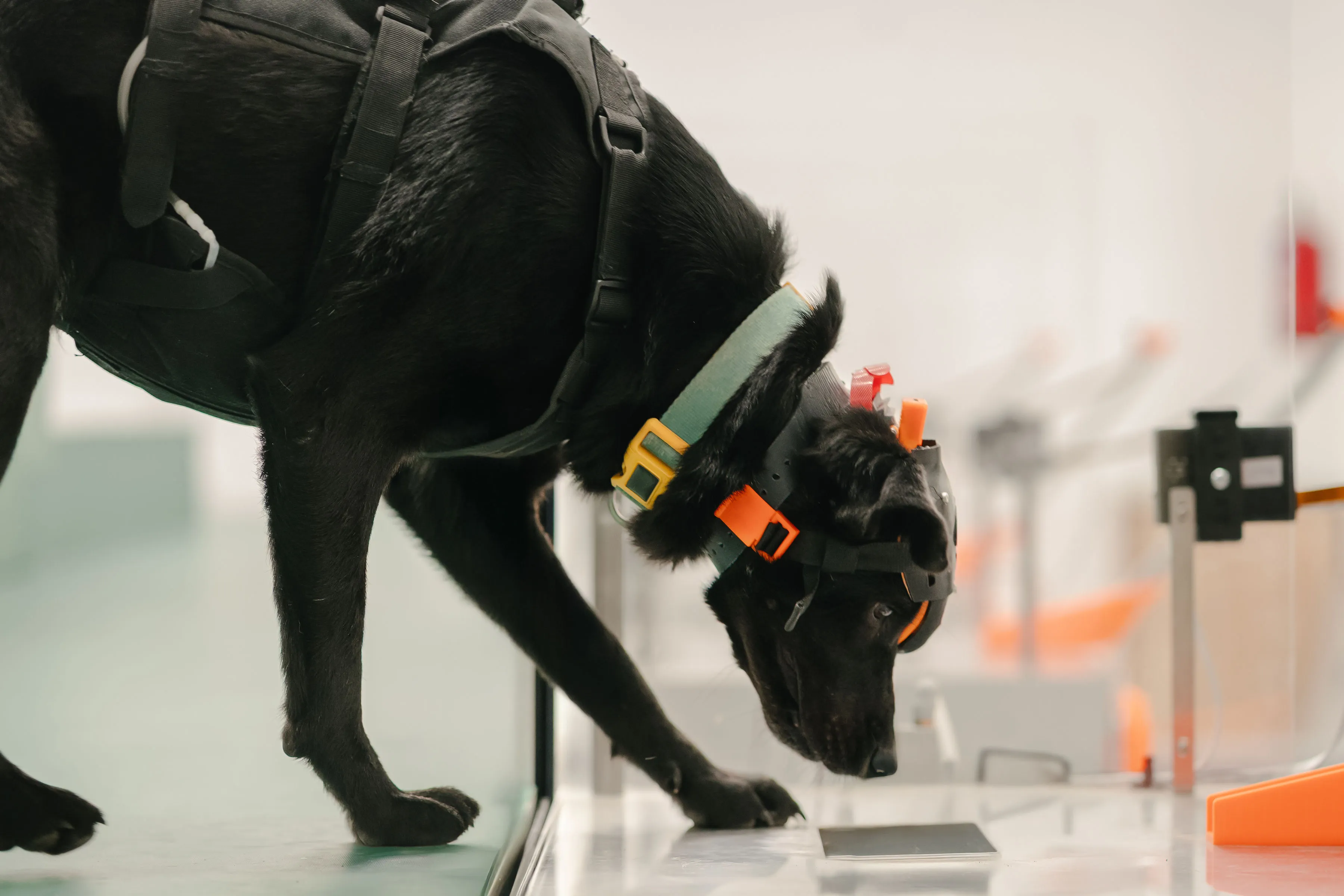
- Outside Bengaluru, the diagnostic breakthrough is partly canine. On a two-acre farm, Billy, Jessie and Banu put on their gear, enter a laboratory packed with samples, and clock in for a shift detecting early signs of cancer. The pairing is the interesting part. The most promising diagnostics are often not the systems replacing a human sense, but the ones combining a machine with a biological detector that already outperforms every instrument we have built.
- And the culture argument continues in parallel. Will.i.am made the case on Bloomberg Television for why human creativity will survive, while the New York Times Magazine examined the communication loops forming between AI chatbots and the internet they were trained on. Both are versions of the same question about what happens to human output when it becomes model input.
The Throughline
The lead story and the macro stories are the same story told at two altitudes. Z.ai's claim is that it can close a capability gap without a larger base model, on a two-month cadence, by getting more out of weights it already has. Read that next to Anthropic's safeguards work, which is also an efficiency claim of a sort: an 85 percent reduction in biology-related refusals is not new capability, it is recovering capability that was already there and being suppressed by a miscalibrated filter. Two labs on opposite sides of a geopolitical divide are both finding their next increment in the same place, which is not in more parameters but in better use of existing ones. That is what a technology looks like when the scaling era stops being the only lever.
The economic stories are where that shift stops being an engineering curiosity. Hong Kong did not raise its growth forecast by a point because models got smarter. It raised it because the investment boom moves physical goods through a trading hub, and export volume shows up in GDP. The Topix breadth number says something similar: when 1,194 of 1,637 stocks rise on a chip-led week, the AI trade has stopped being a sector bet and become a market condition. And Kioxia funding a record week of Japanese corporate buying through a buyback closes the loop, because that is memory-cycle cash from the AI build-out being recycled straight back into equities. The capital is circulating inside the same system that generated it.
The power futures story is the one most likely to be skipped and probably should not be. A fourth consecutive monthly rise in short-term electricity contracts is a small number attached to a large behavioral change: Japanese companies now treat power price risk as something requiring an instrument. Sit that next to Goldman's India assessment and a pattern appears in what people are actually hedging. Firms are hedging electricity, because they believe the cost is going up and staying volatile. Goldman is implicitly telling Indian workers not to hedge at all, because the exposure is low. Both cannot stay true indefinitely, since the reason Indian labor is insulated is that the work is physical, and the entire point of the current robotics push is to make physical work reachable.
There is a tension worth naming between the two Anthropic items. The company loosened biology safeguards to reduce false positives, and in the same window created a senior global affairs role and filled it with a former supreme court justice and foreign policy institution president. Those are not contradictory, but they are in dialogue: a lab making its model more permissive in a genuinely sensitive domain is also a lab building out the institutional apparatus to defend such decisions to governments. Calibration and diplomacy are turning out to be the same job.
The Bigger Picture
For three years the story of AI progress has been legible through a single variable. Bigger model, more compute, better results. Today's lead breaks that frame from an unexpected direction, because the challenger is not claiming scale. Z.ai is claiming it can close a coding gap on the same base model in two months. If that holds, the strategic implication is uncomfortable for anyone whose moat is capital: a compute advantage protects you only while capability tracks compute. When the gains start coming from post-training, from inference technique, from data curation and tooling, the moat becomes talent and iteration speed, and those are far more evenly distributed across borders than fabs are.
The macro data suggests the world has already committed to the capital-intensive version regardless. Hong Kong is forecasting a percentage point of extra growth from it, Japanese firms are hedging the electricity it consumes, a Japanese memory maker is returning so much cash that it moved a national statistic, and Chinese platform companies are publicly managing what it costs them. That is an entire economic region reorganizing around a technology's supply chain. None of that unwinds gracefully if the returns turn out to depend on efficiency work that a fast-moving lab can replicate on existing hardware in two months. The build-out is being underwritten on the assumption that scale stays decisive, at the exact moment competitors are announcing that it is not.
The labor picture is where this lands on people, and Goldman's framing deserves more scrutiny than a reassuring headline gets. Saying India is protected because its workforce does mechanical and physical tasks describes a shelter whose walls are made of the current limitations of robotics. Every serious lab and hardware company is spending heavily to remove exactly that limitation. So the honest version of the finding is not that India is safe, it is that India is later in the queue, and that the sequencing gives it time it can either use to build alternatives or spend assuming the shelter is permanent. Which of those happens is a policy choice being made right now, largely without being framed as one.
The most hopeful item in today's issue is the smallest. Three dogs on a farm outside Bengaluru, working alongside software, detecting cancer earlier than the instruments can. It is a reminder that the highest-value applications of this technology are frequently not substitution at all, but augmentation of something that already worked and could not scale. A dog's nose is not a weaker version of a lab assay. It is a different and in some respects better detector that was never deployable at population scale because it could not be standardized, audited, or read at volume. That is precisely the sort of problem machine learning is genuinely good at, and it produces no displaced worker. There is more of that available than the current build-out is aimed at, and it is worth asking why the capital keeps flowing to the other kind.
What to Watch
- Whether GLM-5.3's coding claims survive independent benchmarking. The claim is company-stated and comes with a specific, checkable structural detail: the same roughly 700-billion-parameter base as the June release. If third-party evaluations confirm a meaningful coding jump on an unchanged base, the significant news is not that a Chinese lab caught up, it is that the post-training frontier is moving faster than the compute frontier, which changes who can compete.
- Whether other governments follow Hong Kong in attributing growth revisions to AI. One jurisdiction adding a percentage point is a data point. If more statistical agencies start explicitly crediting the AI investment cycle in official forecasts, the exposure becomes macro rather than sectoral, and the policy response shifts from technology regulation to something closer to managing a capital cycle.
- Whether Japan's power futures trend extends past four months. This is the cleanest available proxy for whether industrial buyers expect electricity to stay expensive and volatile. A fifth and sixth consecutive month would confirm that the market has repriced power as a structurally risky input, which is a leading indicator for every data center siting decision downstream of it.