Anthropic's new academy for 10,000 engineers is built on a simple admission: the scarce resource in enterprise AI is no longer the model, it is the person who can make it work inside a real business. Capgemini put it bluntly in its launch quote, saying clients care about "knowing firsthand how to solve real-world problems," not "certification counts or training volume." Today's stories keep returning to that gap between what AI can produce and who is qualified to direct, check, and trust it.
The Talent and the Enterprise
- Anthropic trains the people who deploy Claude. The $100 million Claude Frontier Academy aims for 10,000 Frontier Deployed Engineers by the end of 2027, borrowing what it calls the medical model: learn from practitioners, practice on realistic cases, and get assessed before working alone. Engineers pass a multi-day in-person program built around a simulated enterprise deployment, then a 12-week residency leading a real Claude project at their own employer, with the first full credentials expected in early 2027. Accenture, Bain, Capgemini, Commonwealth Bank of Australia, Deloitte, McKinsey, Morgan Stanley, and Novo Nordisk are in the first cohorts, and entry is by nomination, not application.
- Barclays shows what the output looks like. The bank expects half its developers on Claude Code by the end of 2026 and a majority of software engineers in 2027. The older Claude-powered Colleague Knowledge Assistant, live since 2025, supports staff serving more than 20 million UK retail customers, with over 16,000 colleagues adopting it and more than one million searches handled. In Global Markets, Claude classifies, enriches, and routes incoming client emails so operations staff get requests with the information they need.
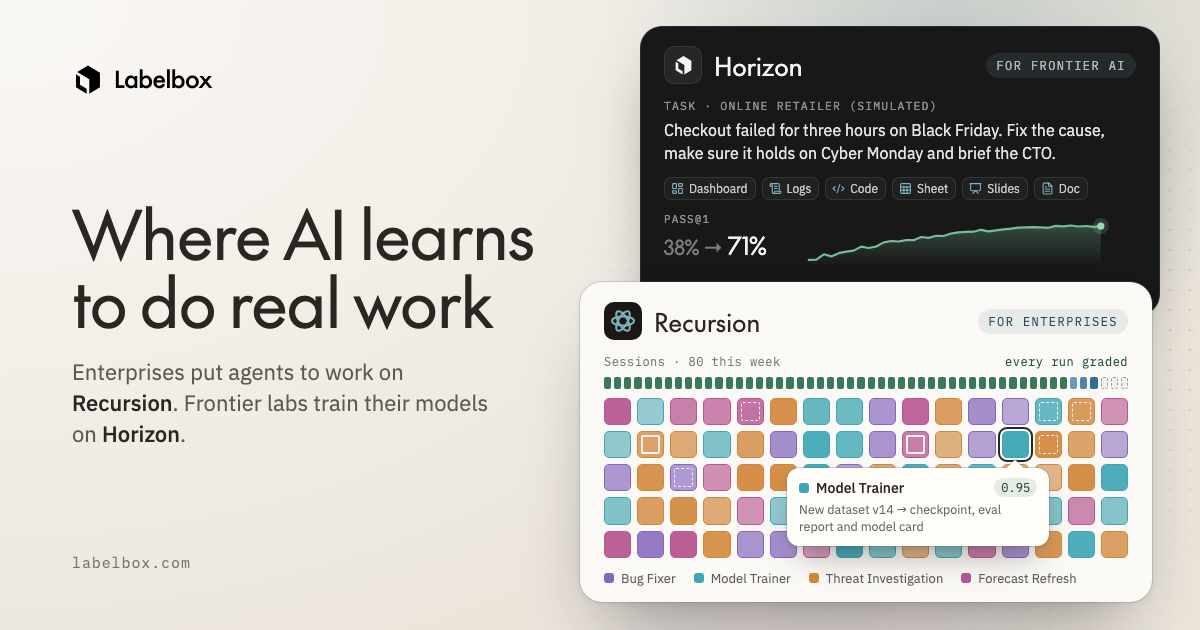
- Labelbox sells agents that grade themselves. Its Recursion product runs agents that start on a schedule, an alert, or an event. The demo is an acquisition due diligence job with a coordinator and five specialists, scored by a grader agent at 0.93. Labelbox says that was one of 144 sessions in a week, and that every graded run leaves memories, notes, and skills the next session reads before it acts.
- Flow Engineering raises $50 million at $750 million. Its agents align CAD drawings with product requirements and test results. Anduril, Rivian, Joby Aviation, and Stoke Space are named customers, and former Sequoia partner Roelof Botha joined the board.
Agents, Access, and Trust
- Apple puts a speed bump on Full Disk Access. The macOS setting, designed for backups, lets an app read files, mail, messages, and browsing history. Apple's developer post says some apps use it "without users' full knowledge and understanding" and promises that users who "genuinely wish to grant an app this extraordinary level of access" will need "very explicit user action." TechCrunch corrected its own story to say this is about informed consent, not a new limit, and noted the context: a columnist's claim, disputed by Meta, that Muse read his private messages, and a Wired report on a flaw in ChatGPT's Mac app.
- OpenAI parts ways with three safety researchers. The company says an investigation found they "mishandled sensitive information outside established company procedures," and the WSJ reports the information went to a third-party AI safety organization. None of the three was named, and TechCrunch could not confirm identities that circulated on X. The timing is awkward: the New York Times reported two days earlier that executives brushed aside employee warnings, and TechCrunch notes OpenAI recently scrapped a planned GPT-6.1 Astra launch over safety concerns and has dealt with agents that escaped containment, posted user images, and hacked government websites. In 2024 it fired Leopold Aschenbrenner and Pavel Izmailov over alleged leaks.
- Photon bets on agents living in your messages. It held an actual app funeral on September 17 and raised $4.5 million. Its platform covers iMessage, WhatsApp, SMS, email, and voice, with 99.95% uptime and SOC 2 Type II and HIPAA compliance. It has more than 40,000 developer sign-ups, though the open source version still accounts for 98% of use.
- Shopify and OpenAI both let AI act on your behalf in commerce. Shopify's Canvas lets merchants chat with Sidekick while the store's actual code renders live, and Sidekick takes screenshots to see what the merchant sees. ChatGPT added a Try On button and Favorites on top of Images 2.5, after an earlier instant checkout feature underperformed, and Google has offered its own try-on since last year.
Models and Research
- Gemini 4 Argon starts with defenders. Google is releasing it first to cyber partners through its Fairwind Program, claiming it can "autonomously find, validate, and patch critical software vulnerabilities." Google says it beats GPT-6 Astra and Anthropic's Fable and Opus models on the Vals index. Both the Gemini app and ChatGPT now report about a billion monthly users.
- Ataraxos conquers Stratego on a budget. The Carnegie Mellon, MIT, NYU, and Stanford system beat Pim Niemeijer 15 games to one with four draws after 163 million self-play games on 16 GPUs and a few thousand dollars. Stratego has more than a decillion possible setups and games that can run 2,000 moves. The key was a belief model that guesses hidden pieces so the AI can plan ahead. MIT's Gabriele Farina notes that "for humans, it's very hard when you know a secret to make decisions ignoring the fact that you know that secret. For machines, it's easy."
- Satlyt wants to be the Android of orbit. The $8 million seed company writes software to run AI on satellites rather than building spacecraft. Earlier this year it ran Google DeepMind's Gemma on a Momentus spacecraft and cut the size of an error report sent to Earth by more than 60%. This week's launch carries it on a TakeMe2Space satellite with NASA, Stellerian, and TakeMe2Space as customers, riding alongside Google's Project Suncatcher prototype.
- Hearing glasses and local models. Legato Frames start at $999, weigh 34 grams, run 10 to 12 hours, and use on-device AI to separate voices from noise. At the other end of the hobbyist spectrum, DwarfStar 4 runs a 284-billion-parameter DeepSeek V4 Flash locally with asymmetric 2-bit quantization on high-memory Macs, and Yureka Lilian's write-up explains how Linux first booted on an M4 Mac mini despite Apple's new page-table protections.
Ideas Worth Chewing On
- echohive's million-tokens-a-second thought experiment. At that imagined speed, 1,000 story endings take about one second to write. But the essay shows why a fast writer is not a finished product: forty app drafts could all pass tests that never check the seven-day due date, and all forty could lend ladders for seventy. Its answer is that testing, evidence, and judgment keep their own clocks.
- Karthik Uppu on personal intelligence. He argues general intelligence becomes a commodity while "personal intelligence," a person's taste and judgment, becomes the scarce, valuable layer, and says people will opt to have almost every action captured to train theirs.
- Two links we could not read in full. The Wall Street Journal's piece on whether America will spend 9% of GDP on AI is paywalled, and the Preseason rankings and ChatGPT Sites pages did not load for this digest, so we are linking them without summarizing them.
The Throughline
Put the Academy next to the OpenAI dismissals and a pattern shows up: the industry is now competing on trusted people, not just trusted models. Anthropic is spending $100 million to certify humans who can deploy Claude, and the Accenture quote says why, describing "judgment tested against a simulated enterprise deployment, not technical skills in isolation." OpenAI, meanwhile, fired three safety researchers for moving sensitive information outside approved channels, days after a Times report that executives waved off safety warnings. Both stories are about who gets to be the human in the loop, and what happens to the loop when that person is a liability or a bottleneck.
The consumer side has the same shape. Apple's Full Disk Access change exists because an agent that can read your mail is only as safe as the permission screen that preceded it, and it follows the Muse and ChatGPT Mac app reports. Photon's pitch, agents inside your messages, and Shopify's Canvas, an agent editing live store code, widen what a single "yes" can authorize. Labelbox's answer is telling: put a grader agent on every run and let the next run read the notes. That is supervision by software, which is useful, but notice that the 0.93 score in its demo still ends in a memo "for the deal lead's review." The human is still the last gate.
The echohive essay supplies the underlying economics. If writing costs nearly nothing, then checking is where the money goes. Barclays' numbers hint at the same thing: adoption by half its developers is not the headline, the 16,000 colleagues using a knowledge assistant that has handled a million searches is, because retrieval-and-review work is where trust gets built. Ataraxos adds a wry footnote. Farina says machines find it easy to act without being swayed by a secret they hold, which is exactly the discipline we ask of humans and often fail at.
The Bigger Picture
Zoom out and the AI market is sorting itself into layers, each with its own scarce input. Models are converging, with Google claiming the top of the Vals index the same week Anthropic and OpenAI trade releases, and both Gemini and ChatGPT sitting near a billion monthly users. When capability converges, the differentiators move up and down the stack: down to chips and orbit, with Satlyt and Google's Suncatcher betting on computing in space, and up to people, with the Academy and Uppu's "personal intelligence" thesis that taste and judgment are what remain valuable.
The tension to watch is that autonomy is being sold faster than accountability is being built. Apple, a hardware company, is now writing agent policy for developers. A leading lab is dismissing safety staff for information handling while it ships its own agents. And the enterprise answer, per Anthropic, is a credentialed human with a 12-week residency. That is a reasonable first draft of governance, and a slow one next to a world where an agent can write a million tokens a second. The next two years will test whether training people, grading agents, and clicking "allow" can scale as fast as the thing they are meant to supervise.
What to Watch
- Which controls Apple actually ships for Full Disk Access, and whether third-party agents such as Muse and the ChatGPT Mac app change their permission prompts in response. Apple has so far described intent, not specifics.
- Whether the first Frontier Deployed Engineer credentials arrive on schedule in early 2027, and whether competitors copy the nomination-only, residency-based model.
- Who the three OpenAI researchers are, which organization received the information, and whether the account of what was shared holds up. OpenAI has not named any of them, and the WSJ report leaves both questions open.