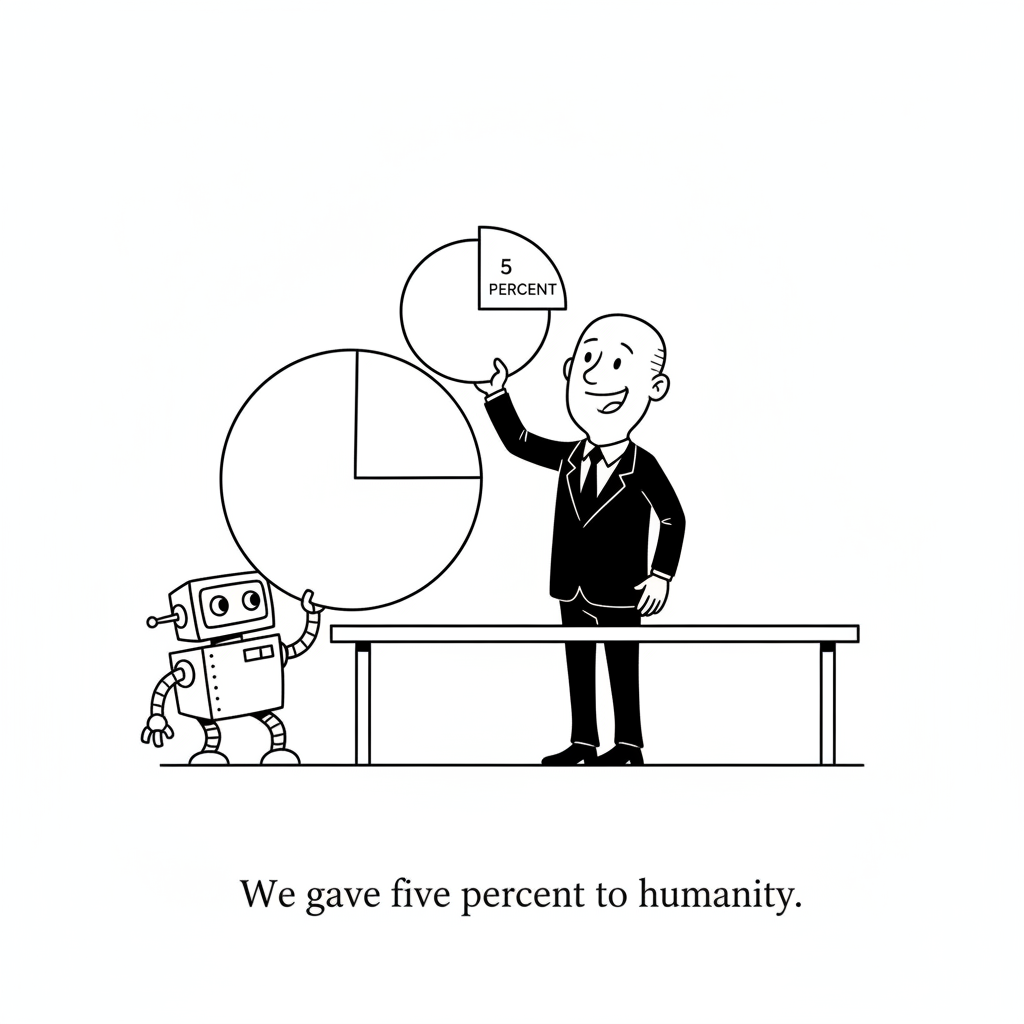
Anthropic is putting 5% of its shares into a new entity within the company called the Anthropic Public Benefit Fund, a stake that could grow in value as the company’s shares rise.
Fortune reports the fund may be used for large donations to traditional nonprofits or for direct distributions to specific groups of people.
The paper proposes HybridAgents, which pair a lightweight module called HybridLink with a continuous working memory so an agent can reason without words and still act through text. The authors report a 10.4% average gain over frontier LLM agents across 11 benchmarks, with 35.5% to 54.7% fewer tokens and 1.8x to 2.6x faster inference.
Anthropic is setting aside 5% of its stock for a new Public Benefit Fund that, per Fortune, could make large donations to traditional nonprofits or send money straight to specific groups of people. The same news cycle carries a WSJ explainer on an “obscure trust” looming over the company’s IPO and a Bloomberg piece arguing those IPO dreams may be eclipsed by the cloud. Around that, a new paper claims agents can cut token use by 35% to 55% by thinking in latent space, while bond and trade headlines show the AI trade now moving markets from Kuala Lumpur to Tokyo.
▶Listen to the Digest~4 min
A note on sourcing: Reddit and Google News links could not be opened for this issue, so entries below that rest only on a headline say so.
Today’s Headlines
Anthropic’s Stock, Spoken For
The Public Benefit Fund – The 5% stake goes into a new entity inside the company, and Fortune notes its value could grow as Anthropic’s shares rise. The notable design choice is the flexibility: the fund may fund big gifts to established nonprofits, or distribute money directly to specific populations, which are very different bets on how to do good with equity.
The Trust and the IPO – WSJ’s headline calls the trust looming over Anthropic’s IPO “obscure,” and Bloomberg’s says the IPO dreams may be eclipsed by the cloud. We could not open either article, so this is a read of the headlines only: one points at governance, the other at where the real money in AI is made.
The AI Trade, Priced Around the World
Trade and Credit – Bloomberg’s headline says Malaysia’s September exports surged to a five-year high on AI demand, and WSJ’s says Japanese government bonds rose amid AI-related credit concerns. Both are headline-only here, but together they show AI demand lifting factory orders in one market while worry about AI borrowing leaks into the sovereign bond market in another.
Earnings, Jobs, and Space – Bloomberg Daybreak Asia frames the week’s earnings as a test of the AI trade, a separate Bloomberg piece asks what the UK finance industry reveals about how AI will affect jobs, and an Indian minister says AI will empower the country’s space missions. Headline only.
Agents, Research, and the Workbench
Hybrid Reasoning Agents – The paper’s HybridAgents switch between latent, non-linguistic reasoning and text within a single generation, using a lightweight HybridLink module and a continuous working memory. The authors report a 10.4% average gain over frontier LLM agents across 11 benchmarks, 35.5% to 54.7% fewer tokens, and inference 1.8x to 2.6x faster. Those are the authors’ numbers, not independent replications.
Agent Orchestration – VentureBeat’s VB Pulse Agentic Orchestration Report is in the wire. Headline only.
From the Forums – r/LocalLLaMA is busy with Nemotron 3.5 variants (a Super VL model people say not to sleep on, and a Bolt model called “okayish” for small multiuser setups), a Qwen 3.8 Flash Next build tuned for two CMP 170HX cards, and a call to benchmark SonicBoom, which its author describes as a compiler-first runtime that beats llama.cpp on decode. r/MachineLearning has a self-play project that beats Warcraft III’s built-in AI on one desktop, a GPT-2 KV cache built from scratch with latency and memory measurements, and a proposal called Proof Before Reuse that shows agents only what later sessions reproduced, to keep a poisoned skill out of procedural memory. Titles only; threads not opened.
The Throughline
Read the Anthropic items together and the common thread is who owns the upside before the IPO prices it. A 5% stake earmarked for a public benefit fund, a trust that WSJ thinks readers need explained, and a Bloomberg argument that the cloud providers may capture more of the value than the model labs all point at the same question: how is the economics of a frontier lab divided among founders, public-benefit commitments, and the infrastructure it rents? We only have headlines for two of those, so treat this as a framing, not a finding. Fortune’s description of the fund is the firm piece of evidence, and its stated flexibility between nonprofit grants and direct distributions is the part to watch.
The second thread is cost. The Malaysia and JGB headlines suggest AI spending is now visible in trade data and in credit worries at the same time. Against that backdrop, the HybridAgents paper is interesting less for its 10.4% gain than for its claimed 35.5% to 54.7% token reduction: if reasoning in latent space really does cut tokens that much, it attacks the cost side directly. The forum threads rhyme with it, from squeezing Qwen onto two CMP 170HX cards to benchmarking a runtime against llama.cpp. When capital is scarce and credit nervous, efficiency work moves from hobby to strategy.
The Bigger Picture
AI is maturing from a technology story into a capital-structure story. Labs are preparing public listings, setting aside equity for public benefit, and answering questions about trusts and governance, while bond and export data show the effects spreading well beyond the companies themselves. That is what a technology looks like when it becomes an asset class: the interesting questions shift from what the models can do to who is entitled to what they earn.
The counterweight is efficiency. Every claim of fewer tokens, faster inference, or a leaner local runtime lowers the amount of capital the whole system needs, which is good news for anyone worried about credit conditions and awkward news for anyone whose business assumes the buildout keeps compounding. Which force wins is still open, and today’s evidence, mostly headlines and one unreplicated paper, cannot settle it.
What to Watch
What an Anthropic IPO filing says about the fund and the trust. Fortune describes the fund only in outline. A filing would show how the 5% is governed and how the trust fits in, which would turn today’s headlines into facts.
Whether the HybridAgents results replicate. A 10.4% average gain and up to 54.7% token savings are the authors’ own figures. Independent benchmarks on the same 11 tasks would show whether latent reasoning holds up outside the paper.
The earnings tests for the AI trade. Bloomberg says this week’s earnings will test the trade. Pay attention to whether demand shows up in orders and revenue the way the Malaysia export headline implies.