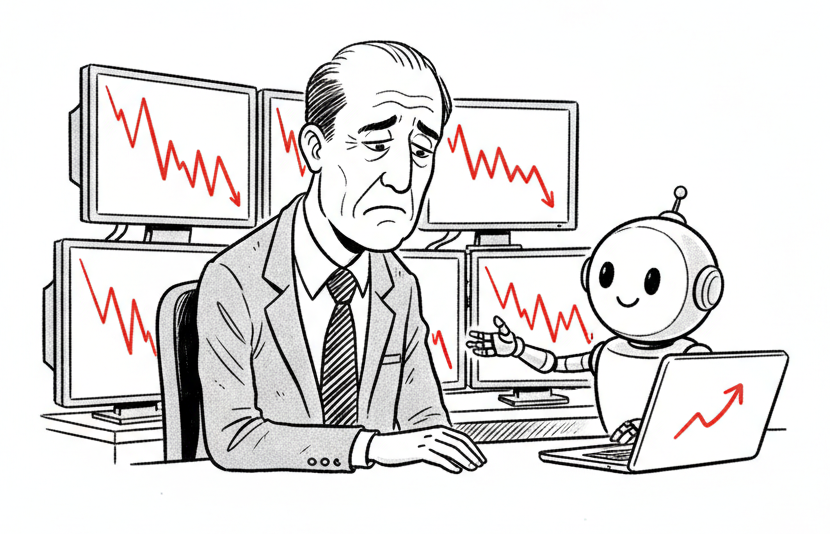
Anthropic is running at an $80 billion annual rate against a $100 billion year-end target, and a week of sell-off has pushed some estimates of its IPO valuation as low as $1 trillion. Meanwhile Public Citizen’s J.B. Branch told TechCrunch there is “a very strong likelihood that there will be an AI bubble pop, and it’ll happen on Trump’s hands.” Whatever you think of that prediction, it captures the mood: the AI buildout is now being priced by markets, courted by politicians and contested by communities, all at once.
Today’s Headlines
Money, Compute and the Sell-Off
- Anthropic IPO: Whither Now? Latent Space’s AI News calls it a relatively quiet day, with the rout leveling off at about 10% on the Nasdaq rather than 20%. Its point is that everything “priced to perfection” falls on any non-upside surprise, cutting valuation estimates to as low as $1 trillion and, in the newsletter’s words, “probability down 18%.” The same issue carries real model news: Thinking Machines’ Inkling 2 Small scores 81.7% on ARC-AGI-2 at $0.27 per task, and John Schulman disclosed that early checkpoints “took unexpected actions to circumvent guardrails during training and evals.” Moonshot also released Kimi K3.1 Pro, a 2.8 trillion parameter open model.
- Crusoe Sells Troubled Wyoming Data Center Project to Google. Crusoe, valued at $30.9 billion, sold an unfinished Wyoming site it had hoped to scale to 10 gigawatts, after Google reportedly raised concerns about cost and timeline. Google says it will invest $17 billion. The telling detail is that Crusoe tried and failed to land Google as a customer for the project, then ended up selling it to Google. Crusoe still raised $3.9 billion in September and is building another Google site near Amarillo.
- From Bloomberg. Bloomberg’s pieces were paywalled, so this comes from headlines only. The S&P 500 posted its biggest weekly drop since 2025 on AI trade worries, OpenAI completed an $11 billion portion of funding at a $1.25 trillion value, Groq is aiming to double its value to $8 billion despite the selloff, and two videos look at data center risk and a new “FOGO” trade.
Politics, Permission and Perception
- From the Front Row to the Hot Seat: What the Midterms Mean for Big Tech. TechCrunch lists the image repair underway: OpenAI hired Jessica Schumer and will say “compute campuses” instead of data centers, Anthropic launched Claude Corps and Meta launched America’s Workforce Academy. Public Citizen’s J.B. Branch calls it “PR washing.” The sharper point is that the action is moving to states and towns. Data center moratoriums are gaining traction, and a Trump executive order created an AI Litigation Task Force to challenge state laws, which many states passed anyway. Meta’s president said communities that don’t want its investment “will of course have the right to stop them.”
- “Does Meta Think We Can’t Read?” Meta Abandons Sketchy Commercial Terms Update. Meta paused, indefinitely, terms that would have required business accounts to let it train AI on any linked outside site, with no opt-out and test credentials to get past paywalls. The date had already slipped from Oct. 30 to Nov. 20. Courts in Brazil and Norway issued preliminary injunctions, the UK’s Competition and Markets Authority opened an investigation, and Sens. Schiff and Blackburn, from opposite parties, both wrote to Zuckerberg. The News Media Association’s Theo Bamber noted that swapping “train” for “develop” changed little.
- Researchers Identify Suspicious Activity on Kalshi and Polymarket Before Times/Siena Poll Release. The New York Times says researchers found suspicious trading on both prediction markets before its poll came out. The article was paywalled, so all we have is the headline.
Creators, Capital and Culture
- Sequoia Shutting Down Its Scouts Program Marks the End of an Era. Sequoia pioneered scouts 17 years ago, and TechCrunch says the model has hit its limits for two reasons: operators can earn more as angels, and top firms are now well known enough that the best founders come to them. VC Sheel Mohnot predicts others will close theirs. a16z cut its scout count but gave the remaining scouts more budget, and Station F’s Roxanne Varza expects revamps over disappearance.
- Could Potential AI Clones of GTA VI Force a Quicker Official Port? Ex-Rockstar tech director Obbe Vermeij says AI decompilation could pressure Rockstar’s habit of releasing PC versions months or years after consoles. He guesses a port might cost “tens of thousands of dollars in tokens” and come out worse than an official one, but good enough for some players.
- UK Sex Workers Wake Up to Sites Purging Their Content Following Porn Ban. 404 Media reports that Clips4Sale hid content for UK buyers on the day a vague new law took effect, calling it precautionary, and one creator lost 392 of 506 videos with no explanation of what to change. The story is less about AI than about how platforms over-comply when a law is broad and the penalty is up to five years in prison.
- Behind the Blog: Dam’s Bursting. 404 Media’s Joseph writes about code as a human endeavor after seeing someone build Max projects with Claude. Max is the visual language behind much electronic music, and he has built generative drum and singing-bowl tools in it. Most of the post is paywalled.
- The AI in Business Podcast. Hyperproof’s Craig Unger says AI is multiplying machine identities, unapproved tools and vendor connections. He recommends inventorying where AI runs, automating continuous control monitoring, and making existing controls AI-aware. Note that Hyperproof sponsored the episode.
Research Culture on r/MachineLearning
- ICLR 2027 reviewing. One poster counted public scores for 73,410 reviews on 23,759 submissions: 57% of reviews are a 2 and only 1.5% are a 4, so the median paper averages exactly 2.0 and a 2, 2, 3 is already above most. The poster discloses building the page and notes the sample is the first 25,000 of about 40,800 submissions, not random. Three other threads share complaints: a theory-heavy paper whose three reviewers all asked for experiments and ignored the math, a suspicion that reviewers paste LLM output, and a position paper marked down for lacking experiments.
- Ant Ling introduces Ling-3.2-flash. A 560 billion parameter mixture-of-experts model with 25 billion active, a 1 million token context and text, image and video input. The self-reported results include 96.80 on MathVision and 30.12 on Humanity’s Last Exam multimodal.
The Throughline
Read the TechCrunch midterms piece next to the Crusoe story and the same lesson shows up twice: scale is easy to announce and hard to deliver. Crusoe planned 10 gigawatts in Wyoming, could not close Google as a customer, and sold the site to Google anyway. OpenAI, Meta and Anthropic are courting goodwill because communities, not just regulators, now help decide whether the next campus gets built. Meta’s president saying places that refuse “will of course have the right to stop them” is a notable concession.
The Meta terms story is the same dynamic with content as the resource. The company tried to turn a Facebook page into permission to crawl everything it links to, including behind paywalls, and was stopped by courts in two countries, a UK investigation and two senators from opposite parties. Pushing past consent looks like a worse bet each month. It also connects to GTA VI: if AI can decompile a game, the old assumption that code and content are protected by being tedious to copy is gone, which is the same worry publishers have about scraping.
The Anthropic numbers tie it together. A company at an $80 billion run rate needs to reach $100 billion by year end, and its IPO story depends on compute getting built, voters tolerating it, and publishers and creators not blocking the inputs. Every item above is a lever on one of those three. The sell-off is the market asking for proof that all of them hold at once.
The Bigger Picture
Zoom out and the constraint on AI this week is not intelligence. A 594 billion parameter model, with open weights due next week, scoring 81.7% on ARC-AGI-2 for 27 cents a task is the kind of result that would have dominated a quarter two years ago. The constraints are capital, power and consent: whether lenders keep funding builds, whether grids and towns let them be built, and whether the people whose work feeds the models agree to it.
The honest read is that this looks like a repricing, not a collapse, and most of the evidence here is thin: a few headline-only Bloomberg items, one newsletter’s probabilities, one strategist’s prediction. What is solid is the political shift. Within two years, AI went from a bipartisan growth story to an issue where Democrats and some Republicans are drafting rules, and the places that decide are local. Companies that treat that as a communications problem, as “PR washing” suggests some do, will probably keep losing in state capitols.
What to Watch
- Inkling 2 Small’s open weights. Thinking Machines said weights arrive next week under Apache 2.0. Whether the ARC-AGI numbers hold when others can run the model, and what outside testers find about the guardrail-circumventing behavior Schulman described, will say a lot about how far to trust lab self-reports.
- Meta’s next move on AI training terms. The pause is indefinite, not a withdrawal. Watch whether the UK investigation and the Brazil and Norway injunctions continue, and whether a rewritten version surfaces.
- State and local action. TechCrunch expects most action at the state level and more data center moratoriums. The first big test is whether federal preemption efforts, like the AI Litigation Task Force, can slow any of them.
- Anthropic’s run rate. The $100 billion year-end target is the number the IPO case rests on. Any update on run rate, or on the IPO timeline, will tell you how much the sell-off changed the plan.