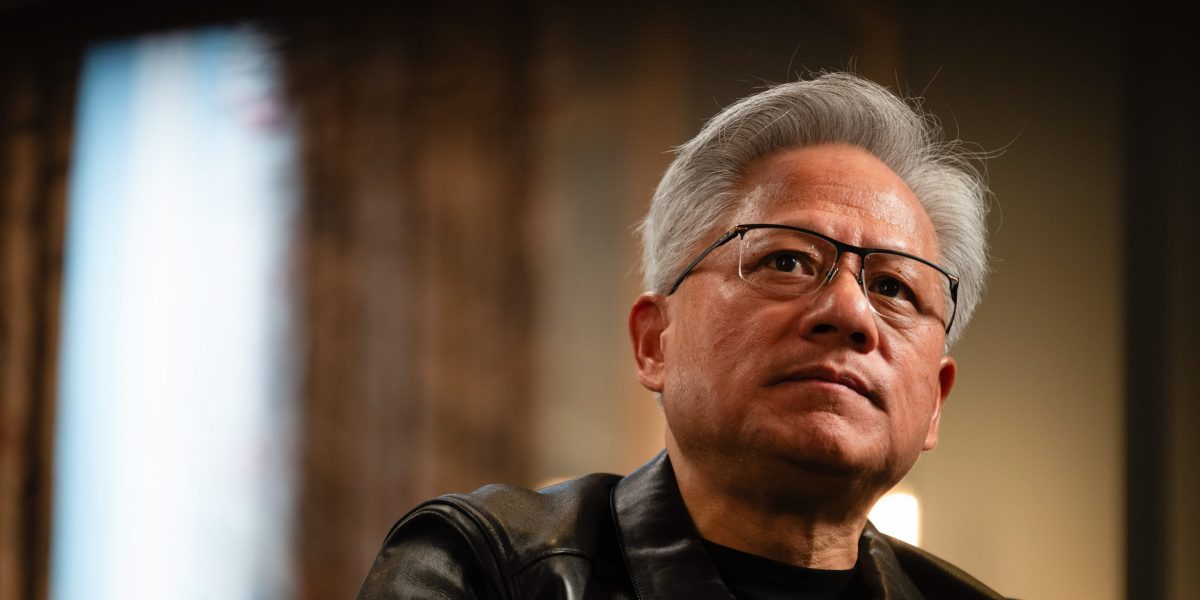
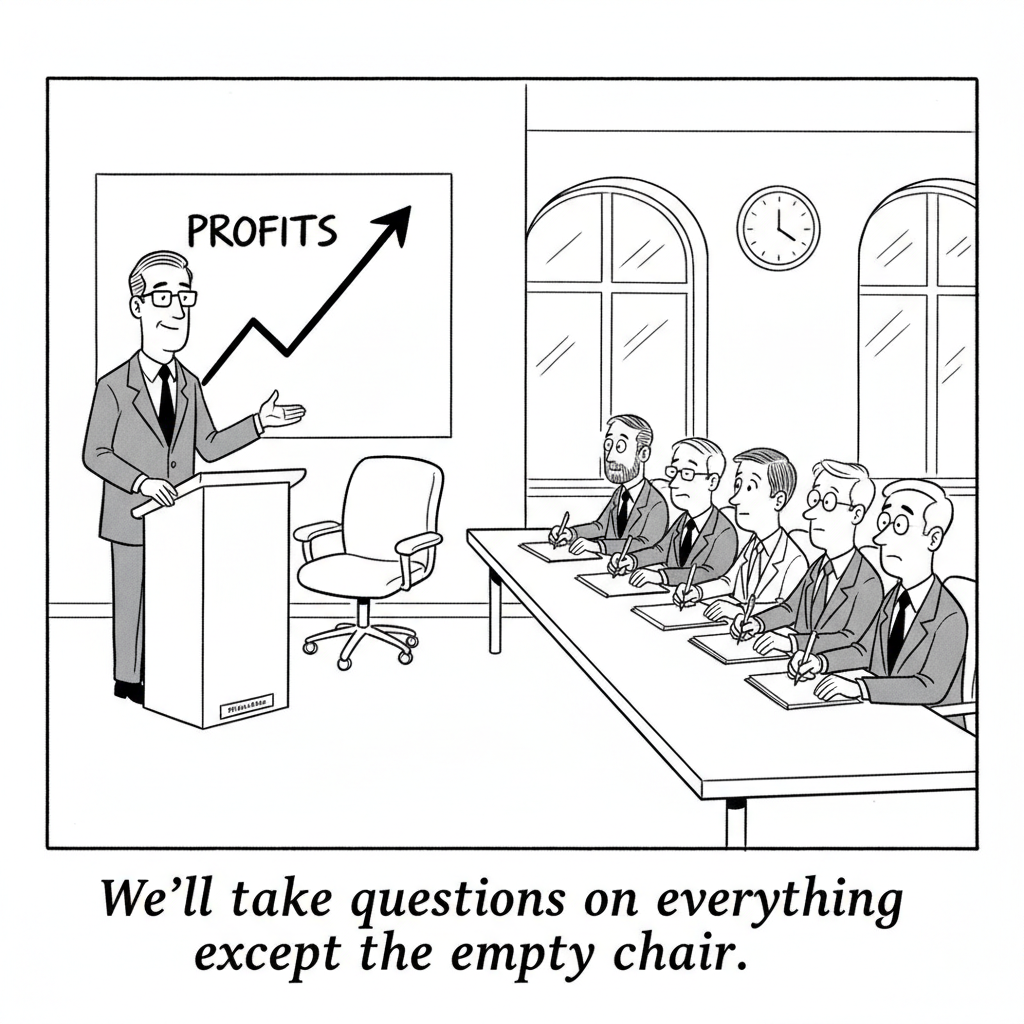
On the first earnings call without its cofounder, Nvidia reported $115.8 billion in quarterly revenue, up 103 percent from a year ago, and its chair announced that the board “does not intend to reinstate Jensen as CEO.” Then he said the company would not take questions about why Huang left. Fortune counted eight analysts on the line and none of them asked. The numbers are enormous and the explanation is missing, and that gap runs through most of today’s stories.
Today’s Headlines
A note on sources: the Fortune, TechCrunch, Ars Technica, WIRED, 404 Media and Consumer Rights Wiki pieces were read in full or nearly so. Bloomberg blocked automated access, so everything attributed to Bloomberg below comes from its headlines alone.
Nvidia After Huang
- The earnings. Interim CEO Colette Kress reported $115.8 billion against guidance of $108 billion, projected $130 billion (plus or minus 3 percent) for the fourth quarter, and raised fiscal 2028 growth to about 75 percent from 70 percent. Nvidia spent $28.1 billion on buybacks in the quarter and has $227.3 billion left to spend. The stock is down about 10 percent since Huang resigned, but rose roughly 4 to 5 percent after hours. Kress’s line was “it’s business as usual.”
- The closed door. Chair Harvey Jones said Huang “voluntarily resigned” on Nov. 12 after disclosure of personal behavior inconsistent with the company’s code of conduct, and that a search firm will consider internal and external candidates. Fortune adds that a report earlier Tuesday said the SEC is investigating whether Nvidia misled investors, and that no analyst asked about Singapore or Megaspeed, the “black box” of where some revenue ends up.
- The investment book. TechCrunch says Nvidia’s equity stakes are now worth $65.5 billion, up from $22 billion in January. It put $16 billion into equities last quarter and $58 billion over nine months, against $5 billion in the same stretch a year earlier. It has backed nearly 350 startups, per PitchBook, and reports $118 billion in guarantees, $105 billion of which backstops OpenAI’s $500 billion Ohio data center. Kress said Nvidia would be “rigorously evaluating future investments, commitments, and guarantees” as other capital becomes available.
- The governance argument. Yale’s Jeffrey Sonnenfeld and coauthors call the “Bring Jensen Back” campaign a case of tech bros casting good governance aside, say the earnings prove Nvidia does not need Huang, and argue that both camps ignore the real collapse of board oversight. It is an opinion piece, and the authors are not neutral.
- Bloomberg headlines. One says the interim CEO states Nvidia is no longer sending AI chips to China, one says “the Bank of Nvidia” is becoming more disciplined and selective, and a video says Nvidia boosted its forecast and quashed Huang’s return. I have not read the underlying reports.
Agents and Work
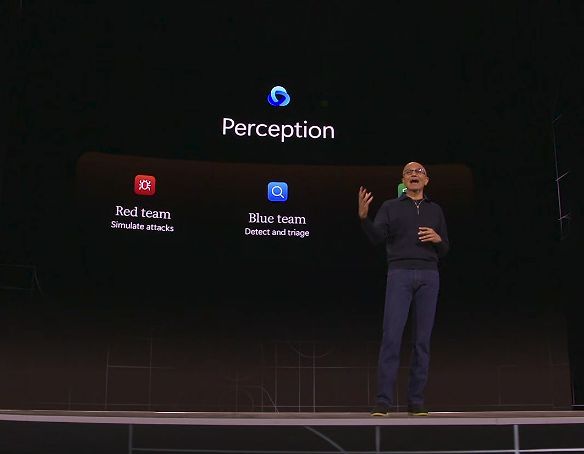
- Copilot as an operating system. Ars Technica says Microsoft made Word, Excel and PowerPoint generally available inside Copilot, with the resulting files still editable in the Office apps. Copilot Autopilot is described as a cloud agent users can delegate responsibilities to, billed by usage through Copilot Credits, with final pricing not yet announced. Microsoft IQ and Work IQ supply the context layer drawn from email, meetings, calendars, chats and files.
- Defense tech. Second Front Systems CEO Tyler Sweatt told Fortune’s forum that Pentagon bureaucracy could become “existential” as AI-enabled drones reshape wars in Ukraine and Iran, and predicted “a tranche of deals” of consolidation within six months. Shield AI announced Nov. 5 that it is raising $2.5 billion to support buying radar maker Echodyne in a deal valued at $5.3 billion.
People and Policy
- Gen Z and AI companions. The Gallup and Digital Wellness Lab survey covered 15,925 people aged 15 to 22 in 16 countries. WIRED reports 33 percent rely on AI for companionship, rising to 50 percent among daily AI users and 42 percent among those with online-only friends. 404 Media adds that 93 percent have at least one strong in-person friendship, that only about 20 percent of young people in the US, Canada and the UK use AI daily versus almost 40 percent in Brazil, and that nearly half of Australians with AI friends rate them high quality against 12 percent in Poland. The researchers say the data cannot show whether loneliness drives AI use or the reverse.
- ID.me and the IRS. The Consumer Rights Wiki notes that IRS sign-in through ID.me carries terms sending most disputes to arbitration unless the user opts out within 30 days. It also notes Login.gov works for the IRS, ID.me replaced TreasuryDirect’s login on Oct. 28, and senators Wyden and Warren asked Treasury on Oct. 29 why it still uses ID.me. This is a community-edited wiki, so check the terms themselves.
- Europe. Atomico’s report says Black Forest Labs and Microagi reached $100 million in revenue in months, and its slogan this year is “build it, scale it, own it.” The firm calls the coming weeks “a really important test” for EU Inc., a proposed single corporate regime across the bloc.
The Wire
- Bloomberg, headlines only. Malaysia is seeking details from Anthropic over an AI influence campaign. Singapore plans to deploy AI against scams and to boost business lending. Infratil’s CEO is optimistic on long-term data center demand. Rubio says recent US tech outages were unrelated and not hostile acts. Ambani wants satellite capacity to challenge Starlink. The remaining two items are market videos.
The Throughline
Nvidia gave investors two stories on the same day and asked them to accept one. The business story is a revenue beat, a higher forecast and $227.3 billion still authorized for buybacks. The governance story is a founder who resigned over conduct, an SEC report, and a Singapore question nobody asked. The Fortune account is blunt that the biggest open question was left unasked: where some of the revenue really ends up. When analysts decline to push, the market is effectively agreeing to trade on the first story alone.
The $65.5 billion investment book makes that bargain bigger. Nvidia is a supplier whose customers include companies it has also funded, and TechCrunch’s numbers show how fast that loop grew: $5 billion of equity purchases in nine months a year ago, $58 billion this year, plus $118 billion in guarantees. Kress’s promise to evaluate future commitments “rigorously” reads differently once you see that the dealmaking was tied to Huang personally, and the Bloomberg headline about the bank of Nvidia becoming more selective points the same way.
Microsoft’s Copilot announcement and the Gallup study look unrelated, but both are about where agents sit relative to people. Microsoft wants agents to drive and applications to ride shotgun. Gallup finds a third of young people already treat an AI as a companion, while cautioning that nobody knows which way the loneliness runs. In both cases the product is moving from a tool you use to a presence you delegate to, ahead of good evidence on what that does.
The Bigger Picture
The AI buildout is now large enough that its governance is a market risk in its own right. Nvidia’s revenue growth of 103 percent is the engine for a lot of other companies’ plans, and the people running it are being investigated, replaced and shielded from questions in the same week. The Sonnenfeld argument is that a company this central needs a board that works regardless of who is in the chair. Today’s call suggests the board is currently managing the message more than answering for it.
The other thread is dependence. Defense startups say the Pentagon has to change or the technology will outrun it, Microsoft is rebuilding its core products around agents, and Europe’s venture community wants its winners to stay European. Each is a bet that AI capability keeps compounding. The Nvidia numbers support that bet today, and the open questions about where those numbers come from are the reason to keep reading the footnotes.
What to Watch
- The SEC report. Fortune says it surfaced the same day as the call. Watch whether Nvidia confirms an inquiry, and whether Singapore and Megaspeed get asked about on the next call.
- The CEO search. The board has hired a search firm and says it will consider internal and external candidates. Whether Kress is made permanent will signal how much of Huang’s dealmaking style survives.
- China. Bloomberg’s headline says Nvidia is no longer sending AI chips to China. The details, and what they do to the guidance, are worth reading in full.
- Copilot Autopilot pricing. Microsoft has not announced final pricing for usage-based Copilot Credits. That number will say how seriously enterprises can budget for delegated agents.